Determinate vs Indeterminate Tomatoes: What's the Difference?
On this page
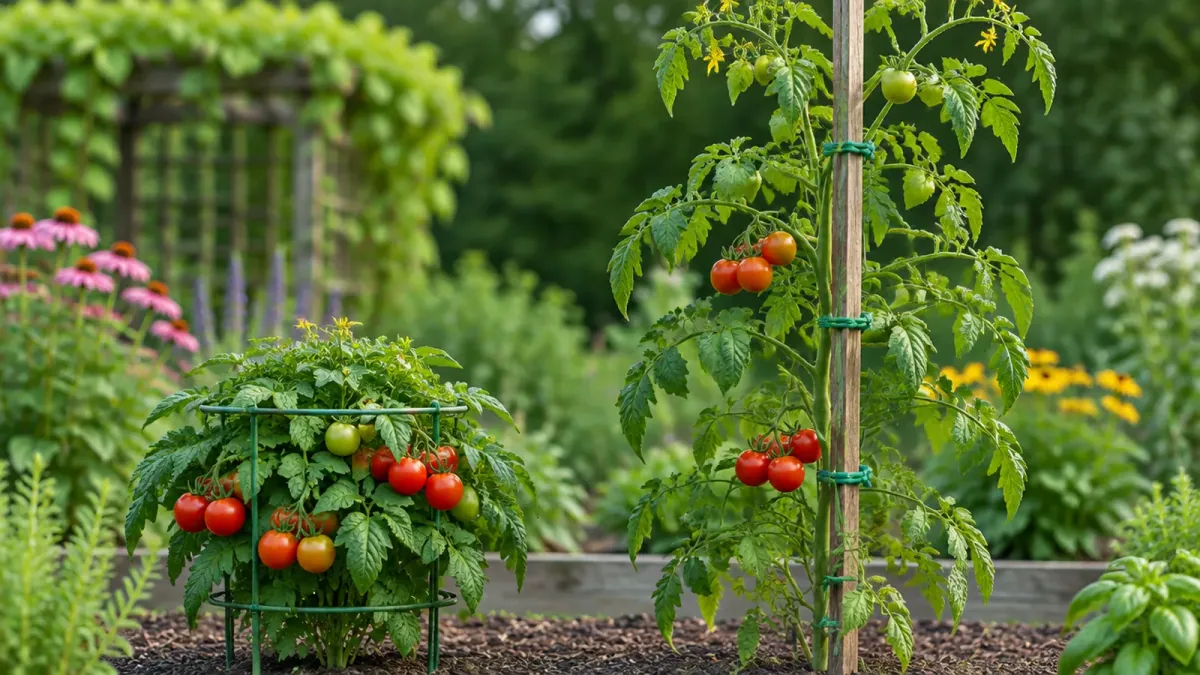
The difference between determinate and indeterminate tomatoes is how they grow. Determinate tomatoes stop at a set height, usually 2 to 4 feet, and ripen most of their crop within a few weeks. Indeterminate tomatoes keep growing, often 6 to 8 feet or more, and produce fruit until frost. Determinates suit pots and canning; indeterminates suit a long harvest.
Determinate vs indeterminate tomatoes compared
| Feature | Determinate | Indeterminate |
|---|---|---|
| Growth | Stops when the main stem ends in a flower cluster | Main stem keeps growing until frost or disease |
| Typical height | About 2–4 ft (sometimes to 5 ft) | About 6–8 ft, often more |
| Harvest pattern | Most fruit ripens over a few weeks | Steady harvest over months |
| Days to first fruit | Often a little earlier | Varies; many are mid- to late-season |
| Pruning | Little or none | Often pruned to 1–4 stems |
| Support | Short cage or stake | Tall stake, strong cage or trellis |
| Containers | Excellent | Possible in very large pots |
| Best for | Canning, sauce in batches, small spaces, short seasons | Fresh eating all summer, maximizing total harvest |
| Examples | ‘Roma VF’, ‘Celebrity’, ‘Bush Early Girl’, ‘Patio’ | ‘San Marzano’, ‘Juliet’, ‘Brandywine’, ‘Sungold’, ‘Early Girl’ |
For more varieties and growing guides, browse our tomato plants hub.
What does determinate mean?
A determinate tomato grows to a predetermined size. As the plant grows, each main stem eventually ends in a flower cluster instead of continuing to grow. Once that happens, the plant puts its energy into ripening the fruit it has set.
The result is a compact, bushy plant, often called a “bush” tomato, that produces most of its crop over a few weeks. After that, it produces little more, though it may set a few late fruits.
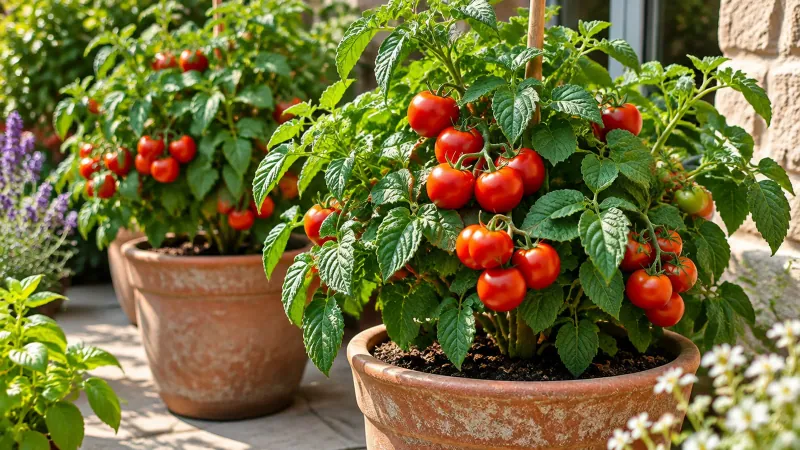
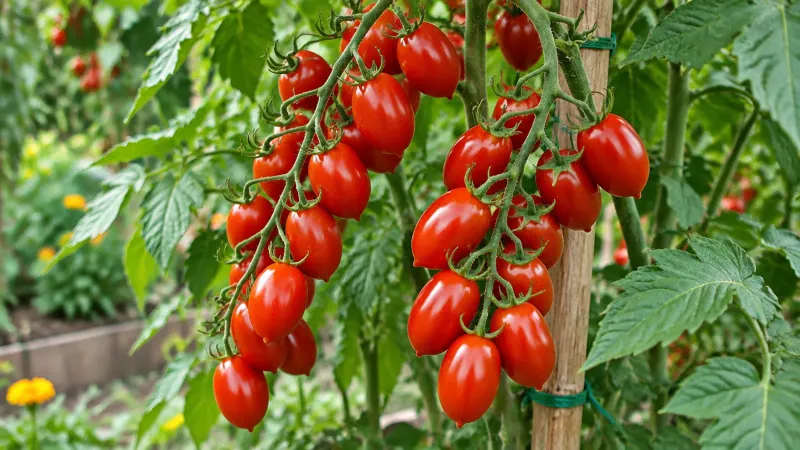
That concentrated harvest is a big advantage if you want to make sauce or can tomatoes in large batches. It is also why determinate types such as ‘Roma VF’ are favorites for processing. Compact determinate varieties are also the best choice for containers; see our guide to patio tomato plants for good examples.
What does indeterminate mean?
An indeterminate tomato never “finishes”. Its main stem keeps growing from the tip, producing leaves and new flower clusters along the way, until frost, disease or the gardener stops it. Fruit ripens a little at a time over many weeks, from midsummer until the end of the season.
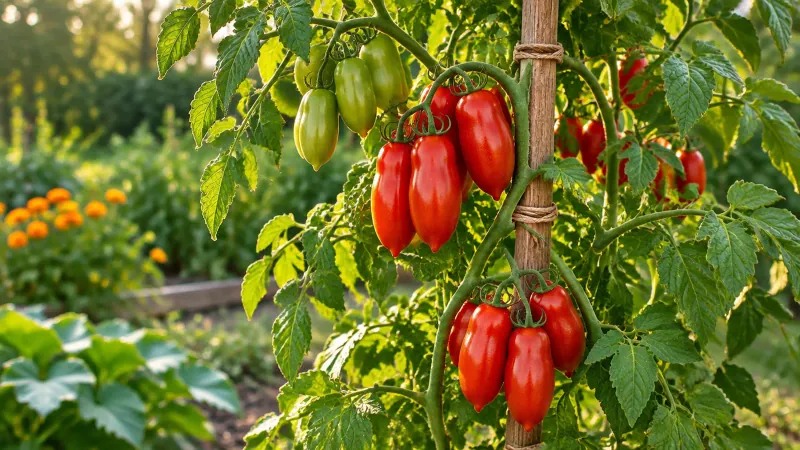
Indeterminate plants grow into long vines that need tall, strong supports. Many of the most popular tomatoes are indeterminate, including most heirlooms, most cherry tomatoes and classic paste types such as San Marzano tomato plants. The vigorous Juliet grape tomato is another good example.
Semi-determinate and dwarf types
Not every tomato fits neatly into one group:
- Semi-determinate (sometimes called intermediate) varieties grow larger than typical determinates and produce over a longer period, but eventually stop. Some popular hybrids are described this way.
- Dwarf indeterminate varieties keep growing and fruiting like indeterminates, but slowly, with short spaces between leaves, so they stay compact enough for pots.
Seed packets usually say which type a variety is. If a label just says “bush”, it is usually determinate; “vining” or “staking” usually means indeterminate.
How to tell which type you have
If you have lost the label, a few clues help, especially once plants start flowering:
- Look at the growing tips. On a determinate plant, the main stem tips eventually end in a flower cluster. On an indeterminate plant, leaves keep growing beyond the newest flower clusters.
- Watch the height. By midsummer, determinates stop getting taller; indeterminates keep climbing.
- Count leaves between flower clusters. Determinates often have fewer leaves between clusters than indeterminates, which typically have about three. This is a rough guide only.
- Check the harvest. If most of the fruit ripens at once and the plant then slows down, it is very likely determinate.
Pruning differences
Determinate tomatoes need little pruning. Their side shoots carry much of the crop, so removing them reduces your harvest. Remove only suckers below the first flower cluster, if you wish, and any yellowing leaves that touch the soil.
Indeterminate tomatoes benefit from some pruning. Removing many of the side shoots (suckers) that grow between the main stem and leaf stalks keeps plants to one to four main stems. This improves airflow, makes plants easier to support and can produce larger fruits. In late summer, pinch out the top of each main stem so the plant ripens the fruit it already has before frost. Our guide on how to prune tomato plants explains the technique.
Support differences
Determinate plants are short but can still flop when loaded with fruit, so a sturdy tomato cage or short stake is usually enough.
Indeterminate plants need much taller, stronger support: a 6- to 8-foot stake, a tall heavy-duty cage, a cattle panel or a string trellis. The small cone-shaped cages sold in garden centers are rarely strong enough. Our comparison of tomato cages vs stakes covers the options.
Which should you grow?
| If you… | Choose |
|---|---|
| Grow in pots or on a balcony | Determinate or dwarf types |
| Want to can or make sauce in big batches | Determinate |
| Have a short growing season | Early determinates, or early indeterminates topped in late summer |
| Want fresh tomatoes from midsummer to frost | Indeterminate |
| Have tall supports and space to grow upward | Indeterminate |
| Want the widest choice of heirlooms and cherries | Indeterminate |
Many gardeners grow a few of each: determinates for a big canning harvest and indeterminates for fresh eating all season. If you are growing in containers, our guide on how to grow tomatoes in pots explains which pot sizes suit each type.
Common myths and mistakes
- “Determinate means early.” Many determinates ripen early, but not all. Some indeterminates, such as ‘Early Girl’, are also early. Check days to maturity on the packet rather than relying on habit.
- Pruning determinates like vines. Removing side shoots from a determinate plant removes the branches that would have carried fruit, and can cut the harvest sharply.
- Undersized supports for indeterminates. A small cage that looks fine in May is usually buried by July. Put tall supports in at planting time.
- Expecting determinates to keep going. Once a determinate plant has ripened its main crop, it slows down. If you want tomatoes until frost, grow some indeterminates too, or plant a second round of determinates a few weeks later.
- Assuming all cherry tomatoes are small plants. Most cherry tomatoes are vigorous indeterminate vines that need just as much support as large slicers.
Topping indeterminate plants in late summer
About four to six weeks before your first expected frost, pinch or cut off the growing tip of each main stem on indeterminate plants, and remove any new flower clusters that won’t have time to ripen. This tells the plant to put its energy into the fruit it already carries, so more of it ripens before cold weather ends the season.
Spacing and planting
Determinate tomatoes are usually spaced about 18 to 24 inches apart. Indeterminate tomatoes need 24 to 36 inches if caged, or about 18 to 24 inches if pruned to one or two stems and tied to stakes. Both types should be planted deep, with the stem buried up to the first set of leaves, after the last frost.
Frequently asked questions
Is it better to grow determinate or indeterminate tomatoes?
Neither is better overall; they suit different needs. Determinate tomatoes are compact, need less support and ripen most of their crop over a few weeks, which suits containers, small spaces and canning. Indeterminate tomatoes grow tall and keep producing until frost, which suits gardeners who want fresh tomatoes over a long season and have room for tall supports. Many gardeners grow both.
Do determinate tomatoes need pruning?
Determinate tomatoes need little or no pruning. Their side shoots carry much of the crop, so removing them reduces the harvest. At most, remove suckers below the first flower cluster and any yellowing or diseased leaves near the soil. Indeterminate tomatoes, by contrast, are often pruned to one to four main stems to keep them manageable.
How tall do indeterminate tomatoes get?
Indeterminate tomatoes commonly reach 6 to 8 feet tall in a typical season, and they can grow 10 feet or more where summers are long and warm. They keep growing until frost, disease or pruning stops them. Plan for supports at least 6 feet tall, and pinch out the growing tip in late summer if a plant outgrows its stake.
Can determinate tomatoes grow in pots?
Yes, determinate tomatoes are the best choice for most pots. They stay compact, usually 2 to 4 feet tall, and need only a short stake or cage. A container of at least 5 gallons suits compact types, though 10 gallons or more gives better results. Indeterminate tomatoes can also grow in pots but need much larger containers and tall support.
Are cherry tomatoes determinate or indeterminate?
Most popular cherry tomatoes, such as ‘Sungold’, ‘Sweet Million’ and ‘Supersweet 100’, are indeterminate and grow into tall, vigorous vines. Some compact cherry varieties bred for pots and hanging baskets, such as ‘Tiny Tim’ and ‘Tumbling Tom’, are determinate. Always check the seed packet or plant label.