Types of Hydroponic Systems Explained (DWC, NFT, Ebb & Flow, Wick)
On this page
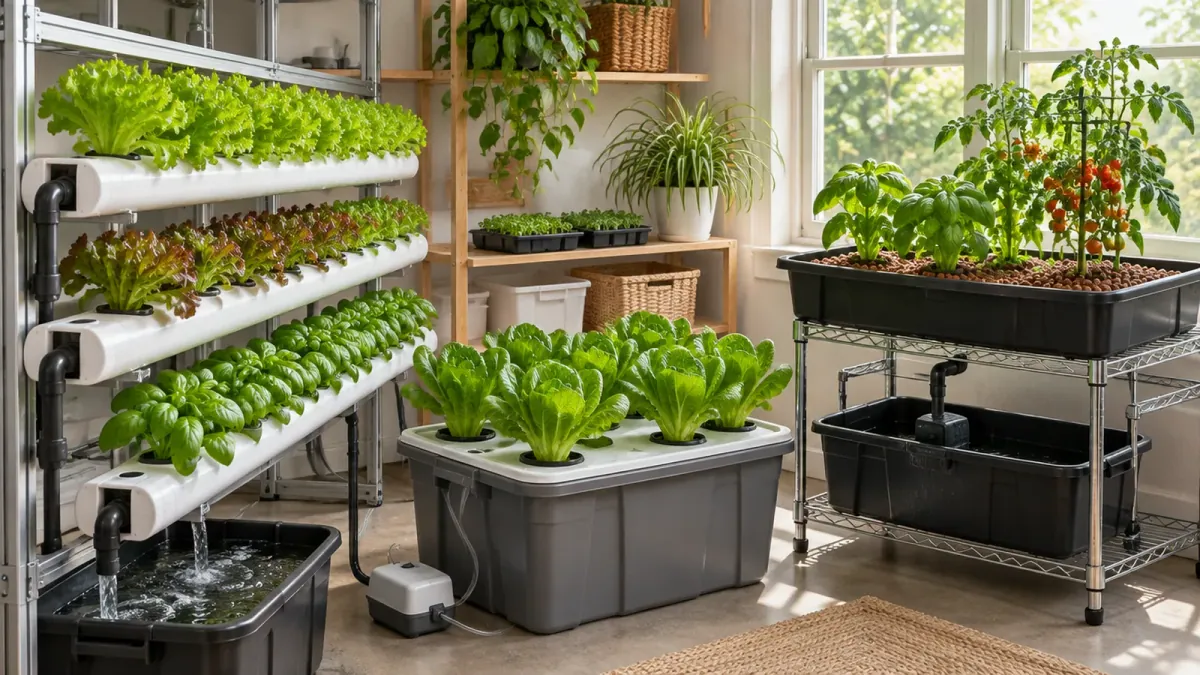
The main types of hydroponic systems are wick, Kratky, deep water culture (DWC), nutrient film technique (NFT), ebb and flow, drip, aeroponics and vertical towers. Passive types such as Kratky and wick need no pump; active types use pumps to deliver water or air. Choose by crop, space, budget and how much attention you can give.
How all hydroponic systems work
Every system has the same goal: give roots water, nutrients and oxygen without soil. They differ in how. In passive systems, water moves by capillary action or by a falling water level. In active systems, pumps move water or air. Roots may sit in water, be flooded and drained, be dripped on, or hang in a mist. If you are new to the idea, start with our guide to hydroponics for beginners, and browse our hydroponics hub for more.
Hydroponic system types compared
| System | How roots are fed | Pump | Best crops | Difficulty | Power-failure risk |
|---|---|---|---|---|---|
| Wick | Wick draws solution up into the medium | None | Small herbs | Very easy | None |
| Kratky | Roots in still solution with an air gap | None | Lettuce, herbs | Very easy | None |
| Deep water culture (DWC) | Roots in aerated solution | Air pump | Lettuce, herbs, some fruiting plants | Easy | Medium |
| NFT | Thin film of flowing solution in channels | Water pump | Lettuce, herbs, strawberries | Moderate | High |
| Ebb and flow | Tray flooded then drained on a timer | Water pump + timer | Most crops, seedlings | Moderate | Low to medium |
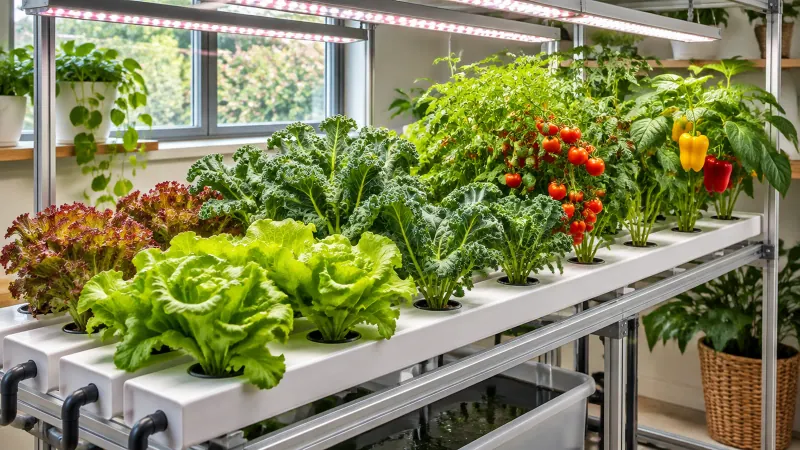
| Drip | Solution dripped onto the medium at each plant | Water pump | Tomatoes, peppers, cucumbers | Moderate | Low to medium |
| Aeroponics | Roots misted with solution | High-pressure pump | Greens, herbs, cloning | Harder | High |
| Vertical tower | Solution pumped to the top and trickles down | Water pump | Greens, herbs, strawberries | Moderate | Medium to high |
Wick system
A wick of absorbent material runs from the plant’s medium into a reservoir and draws solution up by capillary action. There are no moving parts. It is slow and limited, so it suits small herbs and teaching examples rather than big plants.
Pros: silent, cheap, no power. Cons: can’t keep up with thirsty plants; the medium can become waterlogged or salty.
Kratky method
Plants sit in net pots in a lid above a container of nutrient solution. As the plant drinks, the level drops, leaving an air gap that supplies oxygen. Nothing moves. It is ideal for lettuce and leafy herbs. See our guide to the Kratky method for step-by-step instructions.
Pros: no pump or power, cheap, simple. Cons: best for short crops; large plants may outlast the solution.
Deep water culture (DWC)
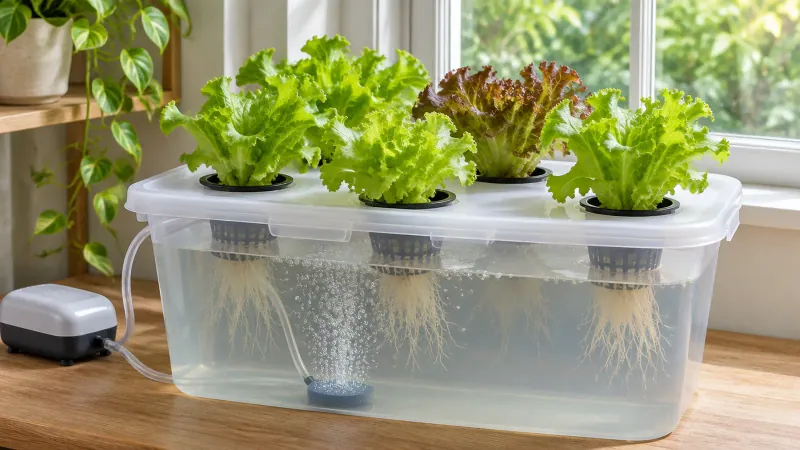
Roots hang in a reservoir of aerated solution, with an air pump and air stone providing oxygen. It is forgiving, fast-growing and scalable from a lettuce tote to individual tomato buckets.
Pros: simple, effective, large water buffer. Cons: warm water can cause root rot; needs the air pump to keep running.
Nutrient film technique (NFT)
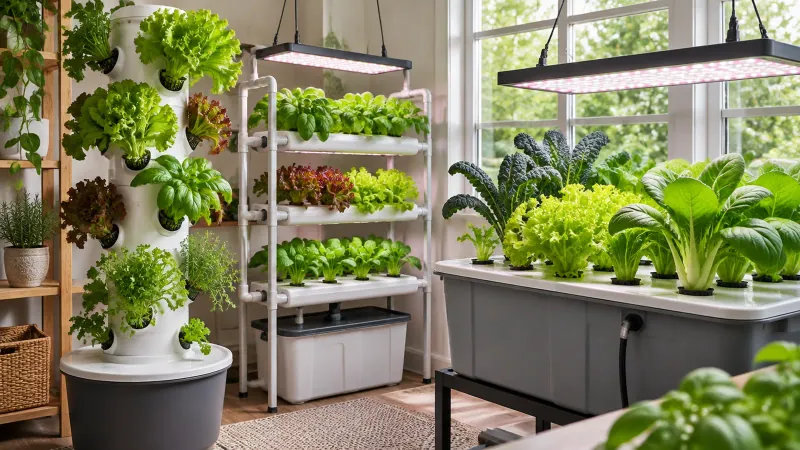
A thin film of solution flows continuously along slightly sloping channels, past the bottom of the roots, and drains back into a reservoir. NFT is efficient for lettuce and herbs and easy to expand with more channels.
Pros: space-efficient, uses little water per plant. Cons: pump failure can dry roots within hours; channels can clog with large roots.
Ebb and flow (flood and drain)
A grow tray filled with pots of medium is flooded with solution on a timer, then drains back to the reservoir. Flooding delivers nutrients; draining pulls fresh air through the medium. It is versatile and good for starting seedlings.
Pros: works for many crops, forgiving of short power cuts. Cons: needs a timer and careful plumbing to prevent overflow.
Drip systems
A pump sends solution through tubes to a dripper at each plant. In recirculating drip systems, excess solution returns to the reservoir; in run-to-waste, it doesn’t. Drip suits large plants such as tomatoes and peppers. Dutch (Bato) buckets are a popular drip design.
Pros: scalable, suits big fruiting plants. Cons: emitters can clog; needs regular checks.
Aeroponics
Roots hang in the air in a dark chamber and are misted with solution. Roots get excellent oxygen, and growth can be rapid. It is also used for cloning.
Pros: very efficient water use, fast growth. Cons: high-pressure pumps and fine nozzles; any failure can harm roots within hours.
Vertical towers
Stacked planting sites around a central pipe, with solution pumped to the top and trickling past roots. Towers fit many greens into a small footprint. Some use NFT-like flow; others are aeroponic.
Pros: compact, good for greens and strawberries. Cons: pumps, plumbing and weight; harder to clean.
Typical costs and effort in general terms
Prices change often, so here is how the systems compare relatively:
| System | Setup cost | Running cost | Daily effort |
|---|---|---|---|
| Wick and Kratky | Lowest | Nutrients only | Almost none |
| DWC | Low | Nutrients plus a small air pump | Low |
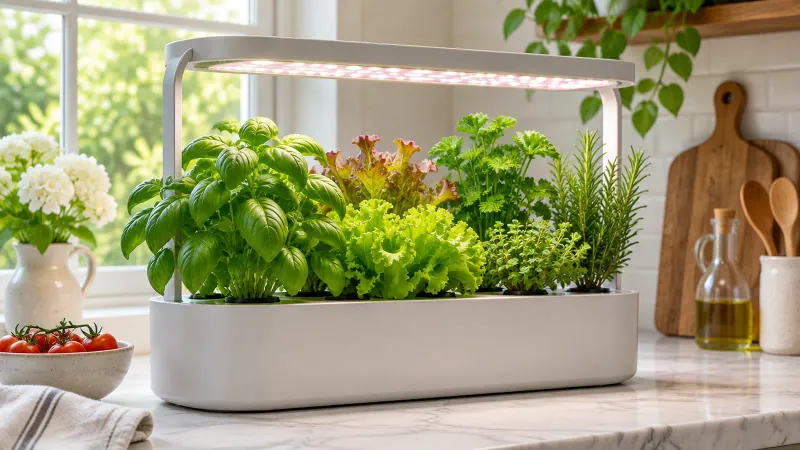
| Countertop kit | Low to medium | Pods or seeds, nutrients, electricity | Low |
| Ebb and flow, drip | Medium | Pump, timer, nutrients | Moderate |
| NFT, towers | Medium to high | Pump, nutrients, lights | Moderate |
| Aeroponics | High | High-pressure pump, nozzles | High |
A simple path from beginner to advanced
Many growers follow a natural progression. Start with a Kratky jar for lettuce to understand the basics. Move to a DWC tote with an air pump to learn about aeration, pH and nutrient changes. Add an NFT rack or tower when you want more plants in a small space. Finally, try a drip or Dutch bucket system for tomatoes or peppers. Each step teaches skills that the next one needs, and cheap early failures cost little.
Which system is the most forgiving of mistakes?
Systems with a large volume of water, such as DWC and Kratky, forgive mistakes in nutrient strength, because the large reservoir changes slowly. Ebb and flow systems with moisture-holding medium forgive short power cuts. NFT, aeroponics and small recirculating towers are less forgiving: with little water around the roots, mistakes show up within hours.
Passive vs active systems
| Feature | Passive (wick, Kratky) | Active (DWC, NFT, drip, etc.) |
|---|---|---|
| Electricity | None | Required for pumps |
| Cost | Lowest | Higher |
| Crop range | Small, short-cycle crops | Wide, including fruiting plants |
| Risk | Low | Pump or power failure |
| Maintenance | Minimal | Regular checks |
How to choose a system
- Choose your crop first. Greens and herbs work in almost any system; tomatoes, peppers and cucumbers need big root zones and strong light.
- Consider space. Countertop, shelf, floor or greenhouse?
- Be honest about time. Passive systems need little attention; active systems need regular checks.
- Consider reliability. If power cuts are common, choose passive or forgiving systems.
- Plan costs. Lights, nutrients, pumps and growing media all add up; see our guide to the best hydroponic growing systems for what to buy, and the guide to the best indoor hydroponic garden for countertop kits.
- Think about expansion. NFT, towers and drip systems are easier to extend.
Choosing by crop
| Crop | Good systems |
|---|---|
| Lettuce and greens | Kratky, DWC, NFT, towers |
| Basil and other herbs | DWC, NFT, countertop kits |
| Tomatoes and peppers | Drip, Dutch buckets, DWC buckets |
| Cucumbers | Drip, Dutch buckets |
| Strawberries | NFT, towers |
| Seedlings and cuttings | Ebb and flow, aeroponics, rockwool in trays |
Our guide to the best hydroponic system for vegetables matches crops to methods in more detail.
What every system needs
Whichever type you choose, you will need hydroponic nutrients, a way to check pH and nutrient strength, and for indoor setups a grow light. Our guide to hydroponic nutrients explains how to mix them, and keep reservoirs cool, clean and covered to prevent algae and root rot.
Common questions about systems
Do I need a different nutrient for each system? Generally no. The same hydroponic nutrient works in most systems, but strength varies with the crop and the stage of growth.
Which system grows fastest? Aeroponics, NFT and DWC are often fastest for greens, but light, temperature and nutrient management usually matter more than the system type.
Which is easiest to clean? Kratky jars and DWC totes are simplest; NFT channels and towers need more careful flushing between crops.
Frequently asked questions
What are the main types of hydroponic systems?
The main types are wick, Kratky (passive), deep water culture (DWC), nutrient film technique (NFT), ebb and flow (flood and drain), drip, aeroponics and vertical towers. Passive systems need no pumps, while active systems pump water or air to roots. Most are variations on how roots get water, nutrients and oxygen.
What is the difference between DWC and NFT?
In deep water culture, roots hang in a deep, aerated reservoir of nutrient solution. In nutrient film technique, a thin film of solution flows continuously along sloping channels past the roots, then returns to a reservoir. DWC is simpler and more forgiving, with a large buffer of water. NFT uses less water per plant but is less tolerant of pump failure.
What is the cheapest hydroponic system?
The Kratky method and wick systems are usually the cheapest, because they need no pumps, electricity or timers. A simple Kratky setup can be built from a jar or tote, a lid and net pots. Deep water culture is only slightly more expensive, needing a small air pump and air stone. Lights add cost indoors in any system.
Which hydroponic system uses the least water?
Recirculating systems such as NFT, drip with return, ebb and flow, DWC and aeroponics use far less water than soil gardening, because water is reused. Aeroponics is often the most water-efficient. In practice, differences between recirculating systems are small, and what matters most is keeping the solution clean and topping up as plants drink.
Can I combine different hydroponic systems?
Yes. Many growers start seedlings in rockwool or coir plugs, grow greens in NFT or DWC, and grow tomatoes in drip or Dutch buckets. Hybrid systems, such as DWC with a top-feed drip, are common. Keep each system’s nutrient strength and pH suited to the crops in it.