The Kratky Method: Passive Hydroponics Made Simple
On this page
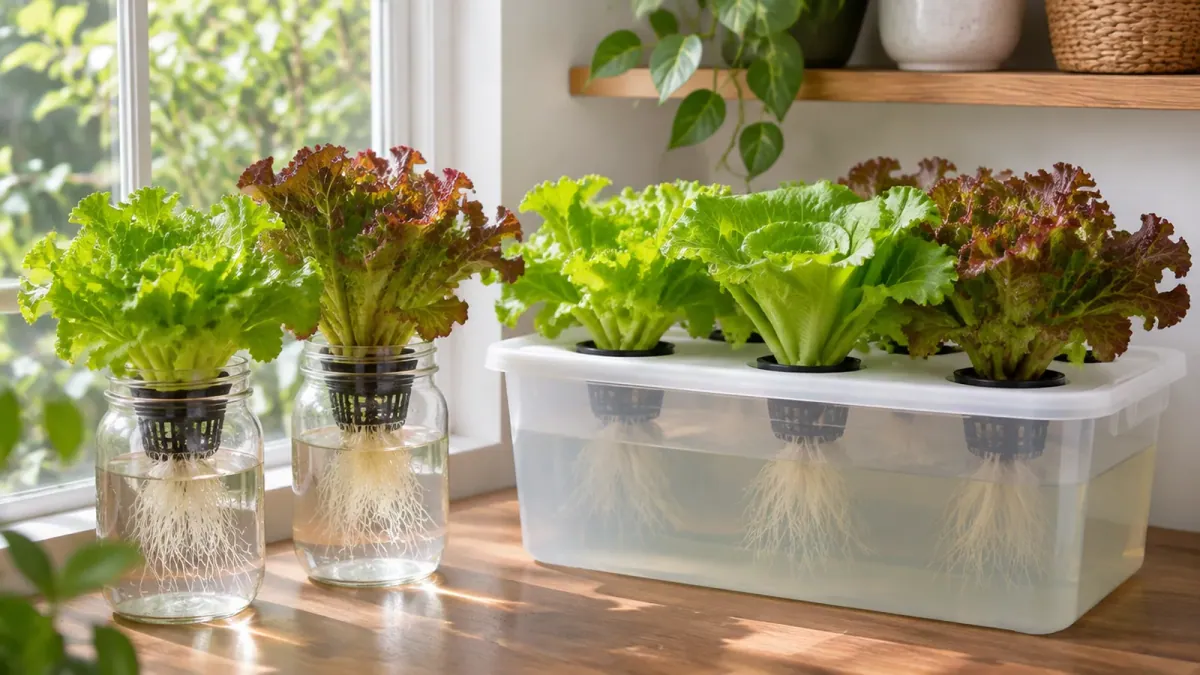
The Kratky method is passive hydroponics: plants sit in net pots above a container of nutrient solution, and as they drink, the falling water level creates an air gap for oxygen. There is no pump, no aeration and no electricity. It is ideal for lettuce, leafy greens and herbs, and it is the cheapest, simplest way to try hydroponics.
What is the Kratky method?
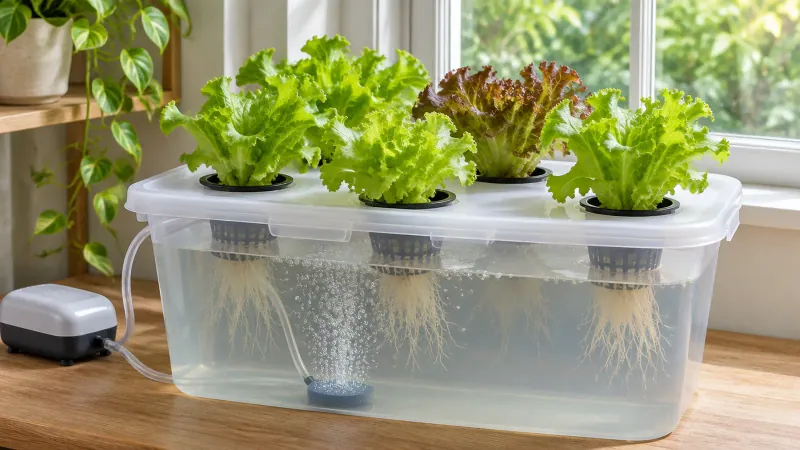
The Kratky method was developed by Professor Bernard (B.A.) Kratky at the University of Hawaii as a simple, low-cost way to grow vegetables without pumps. It works because of a clever trick of oxygen. Early on, the solution touches the bottom of the net pot, so roots reach water. As the plant grows and drinks, the level falls, leaving an air gap above the water. Upper roots, which grow in the humid air, take up oxygen, while lower roots take up water and nutrients.
It is one of the easiest ways to try hydroponics, and it suits classrooms, kitchens and balconies. For other methods, see our guide to the types of hydroponic systems, and for the basics, our hydroponics for beginners guide. More guides live in our hydroponics hub.
Pros and cons
| Pros | Cons |
|---|---|
| No pump, power or timer | Best for short-cycle crops |
| Cheap and simple | Limited by container size |
| Silent | Can’t be adjusted much once started |
| Works in jars, buckets and totes | Warm weather can cause problems |
| Great for beginners and classrooms | Not ideal for large fruiting plants |
What you can grow
| Crop | Suitability | Notes |
|---|---|---|
| Lettuce | Excellent | Loose-leaf and butterhead are easiest |
| Bok choy, arugula, mizuna | Excellent | Fast and compact |
| Spinach | Good | Prefers cooler solutions |
| Basil | Good | Pinch tips; keep warm |
| Mint, chives, parsley | Good | Mint is vigorous |
| Kale and chard | Good | Larger container advised |
| Strawberries | Possible | Need larger containers |
| Tomatoes and peppers | Advanced | Need big containers, support and extra care |
What you need
- A container with a lid. Opaque containers, such as a bucket, tote, painted jar or a black-and-white dual-colored jar, prevent algae. Food-safe plastics are best.
- Net pots (about 2 to 3 inches) and a way to cut holes in the lid.
- Growing medium: rockwool, coir plugs or clay pebbles to support seedlings.
- Hydroponic nutrients, mixed to the label rate.
- A pH test kit or meter.
- Seeds, started in plugs.
- A grow light if you have no bright window.
How to build a Kratky system
Choose a container size
The container must hold enough solution for the whole crop. As a guide, lettuce does well in about 1 gallon per plant. Herbs such as basil need about the same. Large plants need much more. Too little solution and the plant runs out before harvest.
Prepare the lid
- Cut a hole in the lid the size of your net pot, so the pot rests at the rim.
- For several plants, space holes about 6 to 8 inches apart for lettuce.
- Paint or wrap clear containers so no light reaches the solution.
Start seeds
Sow seeds in rockwool or coir plugs, keep them moist and warm, and wait for roots to emerge from the bottom of the plug. Our guide to hydroponic lettuce covers varieties and timings.
Mix the solution
Fill the container with room-temperature water, add hydroponic nutrients at the label rate, and check pH. Aim for about 5.5 to 6.5. Our guide to hydroponic nutrients explains what to use.
Plant
- Place a seedling plug in the net pot, surrounded by medium.
- Fill the container so the solution just touches the bottom of the net pot.
- Set the lid on the container.
- Put the container in a bright spot or under a grow light.
Leave it
Don’t top up the solution. As the plant grows, the level will fall. By harvest, there should still be some solution in the container.
Light and temperature
Lettuce and herbs grow well with 12 to 16 hours of light from a window or grow light. Keep the container out of direct sun, which warms the solution and encourages algae. Try to keep water temperature around 65 to 72°F. Warm water holds less oxygen and encourages root rot. Our guide to grow lights for indoor plants explains what to look for.
Common Kratky problems
| Problem | Likely cause | Fix |
|---|---|---|
| Green algae in the solution | Light reaching the water | Use opaque containers; cover holes |
| Slimy, brown roots | Warm water, root rot | Keep cool; start fresh with clean container |
| Pale, yellowing leaves | Nutrients too weak or pH off | Check pH; mix a fresh batch |
| Brown leaf tips | Nutrients too strong | Start with a lower strength next time |
| Plant wilts before harvest | Solution ran out | Use a bigger container next crop |
| Drowned roots | Topped up the water | Don’t refill; keep the air gap |
| Bolting (flowering early) | Heat or long days | Harvest early; choose heat-tolerant varieties |
When can you top up?
In a pure Kratky system, you don’t. Topping up fills the air gap that provides oxygen. If a long-cycle crop runs low, some growers add a small amount of plain or lightly fertilized water while still keeping a gap, or switch to a modified approach such as adding a small air pump. For long crops, choose a larger container instead.
Kratky variations
- Jar Kratky: mason jars for herbs and baby greens.
- Tote Kratky: a large tote with several holes for lettuce or kale.
- Bucket Kratky: one big plant per bucket, as with a tomato, though success depends on managing the water level.
- Hybrid Kratky: adding an air stone for crops that need more oxygen.
Is the Kratky method right for you?
If you want to try hydroponics cheaply, grow lettuce or herbs, or teach children how plants grow, it is hard to beat. If you want faster growth, larger fruiting crops or continuous harvests, a system such as deep water culture or drip is a better fit; our guide to the best hydroponic growing systems explains your options, and our guide to building a DIY hydroponic system shows other simple builds.
Frequently asked questions
What is the Kratky method?
The Kratky method is a passive hydroponic technique developed by Professor B.A. Kratky at the University of Hawaii. Plants sit in net pots in a lid above a container of nutrient solution, with no pump, aeration or electricity. As the plant drinks, the water level falls, leaving an air gap that supplies oxygen to the upper roots while the lower roots stay in the solution.
What can you grow with the Kratky method?
Leafy greens and herbs grow best: lettuce, spinach, bok choy, arugula, basil, mint and chives. Short-cycle crops that finish before the solution runs low work well. Larger plants such as tomatoes and peppers have been grown with Kratky in big containers, but they need more volume, support and refilling, so beginners should start with lettuce or herbs.
Do you add water to a Kratky system?
In a classic Kratky system, you don’t add water after planting, because the falling water level creates the air gap roots need. Topping up fills that gap and can drown the upper roots. Some growers top up modestly with plain water late in a long crop, keeping a gap. Choose a container size that holds enough solution for the crop’s life.
How long does a Kratky jar last?
It depends on the container size and the plant. A small jar of herbs may last two to four weeks before needing attention, while a lettuce in a gallon jar or a larger tote can last four to six weeks until harvest. Larger plants drink more quickly. Size the container so that about half of the solution remains at harvest.
Why is my Kratky lettuce failing?
Common causes are too much light reaching the solution (algae), warm water, nutrient strength too high or low, using a container that is too small, or topping up the water so the air gap disappears. Check that the container is opaque, keep the room cool, measure pH and nutrients, and leave the air gap.