DIY Hydroponic System: Build a Simple Setup at Home
On this page
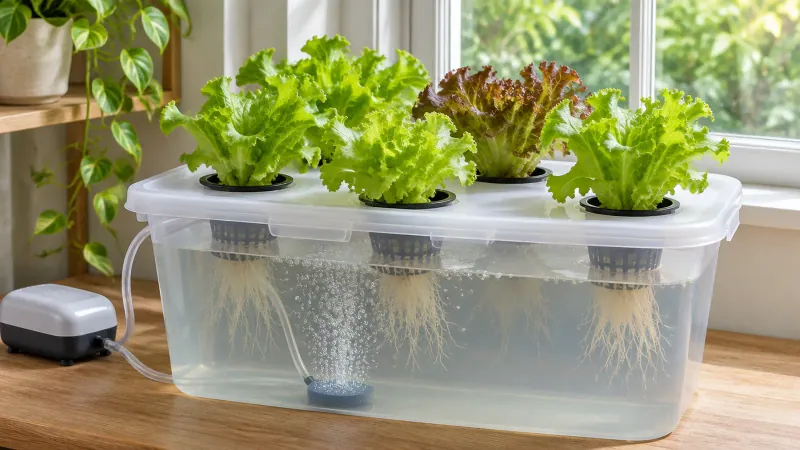
A DIY hydroponic system can be as simple as a Kratky jar, with no pump, or a deep water culture bucket, with an air pump and air stone. Use opaque, food-safe containers, net pots, a growing medium and hydroponic nutrients, keep pH around 5.5 to 6.5, and start with lettuce or herbs.
How hydroponics works
In hydroponics, plants grow with their roots in nutrient water instead of soil. The roots get water, nutrients and oxygen, and the plant is held up by a net pot and a medium. Systems differ in how they deliver oxygen: Kratky relies on an air gap, DWC bubbles air through the water. For the basics, see our guide to hydroponics for beginners, and our guide to types of hydroponic systems. More guides are in our hydroponics hub.
Pick your DIY design
| Design | Complexity | Needs power? | Best for |
|---|---|---|---|
| Kratky jar or tub | Very easy | No | A few lettuce or herb plants |
| DWC bucket | Easy | Yes (air pump) | Faster growth; herbs, greens, peppers |
| Wick system | Easy | No | Small herbs; slower |
| Ebb and flow tray | Moderate | Yes | Mixed crops |
| NFT channel | Moderate | Yes | Rows of lettuce |
This guide covers the first two, the easiest to build. Our guide to the Kratky method goes deeper on that approach.
Build 1: Kratky jar or tub
Parts
- A food-safe, opaque container with a lid (or a jar wrapped in foil or painted).
- A net pot (or a cut plastic cup) that fits a hole in the lid.
- A growing medium: clay pebbles or rockwool.
- A seedling started in rockwool.
- Hydroponic nutrients for leafy plants.
- A pH test kit.
Steps
- Cut a hole in the lid just smaller than the lip of the net pot, so it sits snugly.
- Prepare the seedling in a rockwool plug, soaked in pH-adjusted water.
- Place the plug in the net pot with a little medium around it.
- Mix nutrient solution according to the label, and check pH at 5.5 to 6.5.
- Fill the container so the water touches the bottom of the net pot at first.
- Set the net pot in the lid and close it, keeping light out.
- Leave it alone. As the plant drinks, the water level drops, and an air gap forms for roots.
- Don’t top up until the plant is large; if needed, add water without covering all the roots.
Light-proofing is crucial. Algae grow quickly in lit water.
Build 2: Deep water culture (DWC) bucket
Parts
- A 3- to 5-gallon opaque, food-safe bucket with a lid.
- A net pot (3 inches) and a lid hole saw or sharp knife.
- An air pump, airline tubing and an air stone.
- Growing medium and a seedling.
- Nutrients and a pH test kit.
- Optionally, an EC or TDS meter.
Steps
- Cut a hole in the lid for the net pot, and a small hole for the air tube.
- Connect the air stone to the airline tubing and place it in the bottom of the bucket.
- Run the airline up through the lid hole, with a loop above the water level to prevent back-siphoning, and attach it to the air pump placed above the water.
- Fill the bucket with water and mix in nutrients; check pH.
- Place the net pot with the seedling in the lid so the roots can reach the water.
- Turn on the pump so the water bubbles gently.
- Check daily: water level, pH and root color. Top up with plain water.
- Change the solution every one to two weeks.
The air pump should stay above the water level, and you should use a ground-fault circuit interrupter (GFCI) outlet for safety.
Choosing parts
| Part | What to look for |
|---|---|
| Containers | Food-safe, opaque, with a lid; never ones that held chemicals |
| Net pots | Slotted sides for root growth |
| Medium | Clay pebbles are reusable; rockwool holds water; coco coir is organic |
| Air pump | Quiet and sized for the number of buckets |
| Air stones | Fine bubbles are better |
| Nutrients | Formulated for hydroponics, not garden fertilizer; see hydroponic nutrients |
| pH test kit | Liquid drops or a digital meter |
| Lights | A full-spectrum LED on a timer for indoor growing |
Light for your DIY system
A bright south-facing window can work for herbs in warm months, but most indoor setups need a grow light. Use a full-spectrum LED on a timer for 12 to 16 hours a day. For options, see our guide to grow lights for indoor plants.
What to grow first
| Plant | Why |
|---|---|
| Lettuce | Fast, forgiving; see hydroponic lettuce |
| Basil and mint | Fast and productive |
| Spinach and kale | Cool-season greens |
| Strawberries | Possible in larger systems |
| Peppers and tomatoes | Need more light, support and space; see hydroponic tomatoes |
Troubleshooting
| Problem | Cause | Fix |
|---|---|---|
| Green slime | Algae from light in the reservoir | Block light; clean the system |
| Brown, slimy roots | Root rot from warm water, low oxygen | Cool water, add aeration, clean and restart |
| Yellow leaves | Nutrient imbalance or wrong pH | Test and adjust |
| Slow growth | Weak light or low nutrients | Increase light; check EC |
| Wilting | Roots not reaching water | Lower the water level, or top up |
| Leaks | Poor seals or cuts | Check fittings; use silicone sealant rated for aquariums or food use |
Safety tips
- Use a GFCI outlet and keep all electrical parts above water level.
- Run airlines with a loop to stop water siphoning into the pump.
- Keep nutrients out of reach of children and pets.
- Wash hands after handling nutrients and roots.
- Use food-safe containers, especially for edible plants.
- Clean reservoirs between crops with a diluted sanitizer and rinse well.
Pets
Keep pumps, cords, buckets and nutrient solutions away from pets, and check the ASPCA list for any plants you grow where animals can reach them.
Maintenance schedule
| Task | How often |
|---|---|
| Check water level and top up | Every day or two |
| Check pH | Every 2–3 days |
| Check EC or TDS | Weekly |
| Change the nutrient solution | Every 1–2 weeks |
| Clean the system | Between crops |
Frequently asked questions
What is the easiest DIY hydroponic system to build?
The Kratky method is the simplest: a light-proof container filled with nutrient solution, a net pot holding the plant, and no pumps or electricity. A deep water culture bucket with an air pump is the next step up and suits faster growth. Both can be built from inexpensive, widely available containers and basic parts.
What do I need to build a hydroponic system?
At minimum you need an opaque container, a lid with holes, net pots, a growing medium such as rockwool or clay pebbles, seeds or seedlings, hydroponic nutrients and a pH test kit. DWC systems add an air pump, tubing and an air stone. Plants indoors also need a grow light and a timer.
Can I use any container for a DIY hydroponic system?
Use food-safe, opaque containers that block light, since light in the reservoir grows algae. Dark buckets and tubs work well. Avoid containers that held chemicals, and don’t use clear jars without wrapping them in foil or paint. Make sure lids fit well and are cut cleanly for net pots.
What plants grow best in a DIY system?
Leafy greens such as lettuce, herbs such as basil and mint, and spinach grow easiest because they are light and fast. Strawberries and peppers work in larger systems with good light. Large, heavy fruiting plants such as tomatoes need bigger buckets and support, so start with greens before moving up.
How much does a DIY hydroponic system cost?
A simple Kratky jar can cost very little, because it uses containers you already have plus a few supplies. DWC and larger systems cost more for pumps, lights and meters. Costs vary by region and supplier, so compare parts before buying, and add the lights and nutrients to your budget.