How to Grow Hydroponic Tomatoes
On this page
To grow hydroponic tomatoes, choose a compact or cherry variety, use a system with a large root zone such as Dutch buckets or deep water culture, give strong light for 14 to 16 hours, keep pH near 5.8 to 6.3, feed by growth stage, support the vines and pollinate flowers by hand indoors.
Why grow tomatoes hydroponically?
Hydroponic tomatoes can grow quickly and yield well, can be grown year round indoors, and avoid soil pests and diseases. Commercial growers use hydroponics for exactly these reasons. At home, tomatoes are more demanding than lettuce, so they are a good second project after you have learned the basics. For more guides, visit our hydroponics hub, and see our guide to hydroponics for beginners.
Choose the right variety
| Type | Examples | Notes |
|---|---|---|
| Cherry and grape (indeterminate) | ‘Sungold’, ‘Sweet 100’ | Productive, forgiving |
| Compact or dwarf | ‘Tiny Tim’, ‘Micro Tom’ | Good for small systems |
| Slicers (indeterminate) | Greenhouse varieties | Need more room and support |
| Determinate types | ‘Roma’, ‘Patio’ types | Compact; fruit ripens over a shorter window |
Greenhouse or indoor-bred varieties are made for protected growing. Large vining plants need space, so choose a size to suit your setup.
Choose a system
| System | How it works | Suits tomatoes? |
|---|---|---|
| Dutch bucket (bato) | Drip-fed buckets with medium | Excellent for large plants |
| Deep water culture (large bucket) | Roots hang in aerated water | Good; needs aeration and cool water |
| Drip system | Emitters feed pots or slabs | Excellent |
| Ebb and flow | Tray floods and drains | Good for compact types |
| Kratky | Passive reservoir | Possible for small plants only |
| NFT | Thin film in channels | Poor for large plants |
See our guide to types of hydroponic systems and our list of the best vegetable hydroponic systems.
What you need
- A system with a large root zone (at least 3 to 5 gallons per plant).
- A growing medium, such as clay pebbles, perlite or coco coir.
- Tomato seeds or seedlings.
- A hydroponic nutrient formulated for fruiting plants; see our guide to hydroponic nutrients.
- pH and EC meters.
- A strong full-spectrum LED grow light, with a timer.
- Stakes, trellis or string to support vines.
- A fan for airflow.
How to grow hydroponic tomatoes
- Start seeds in rockwool or coco plugs, kept warm (about 70 to 80°F) and bright.
- Provide light as soon as seeds sprout; 14 to 16 hours a day.
- Transplant when seedlings have several true leaves and roots visible, burying the stem slightly if using a loose medium.
- Mix nutrients at seedling strength, then increase as plants grow.
- Check pH and aim for about 5.8 to 6.3.
- Support the plant early with string or a trellis.
- Prune suckers on indeterminate plants, keeping one or two main stems.
- Pollinate flowers by hand when blooms open.
- Harvest when fruit is fully colored.
Nutrients and feeding by stage
Tomatoes change nutrient needs as they grow. Use a formula for fruiting plants and follow the manufacturer’s stage-by-stage schedule.
| Stage | Focus | EC (typical guide) |
|---|---|---|
| Seedling | Gentle feeding | About 1.0–1.5 mS/cm |
| Vegetative growth | Nitrogen for leaves and stems | About 1.8–2.5 mS/cm |
| Flowering and fruit set | More potassium and phosphorus | About 2.5–3.5 mS/cm |
| Fruiting | Steady feeding; watch calcium | About 2.5–3.5 mS/cm |
These are typical ranges, so rely on your nutrient label. Check pH daily at first, then every few days, and change the reservoir regularly. See our guide to pH and EC for hydroponics.
Light, temperature and airflow
| Factor | Target |
|---|---|
| Light | Strong full-spectrum LED, 14–16 hours |
| Air temperature | 70–80°F by day, 60–65°F at night |
| Water temperature | Below about 72°F if possible |
| Humidity | Moderate; avoid constantly high humidity |
| Airflow | A gentle fan to strengthen stems and help pollination |
For more on lights, see our guide to grow lights for indoor plants.
Pollination indoors
Tomato flowers need movement to release pollen. Each day when flowers are open, gently shake the trusses, tap them or touch the flower stems with a vibrating tool such as an electric toothbrush. A fan also helps. Good pollination gives well-shaped fruit; poor pollination causes flower drop and small, misshapen tomatoes.
Support and pruning
Indeterminate tomatoes grow tall. Train them up a string clipped to an overhead support or a strong trellis. Remove suckers, keeping one or two main stems, and remove lower leaves as plants grow. Determinate types need little pruning.
Common problems
| Problem | Cause | Fix |
|---|---|---|
| Flowers drop | Poor pollination, heat, low light | Pollinate; improve light; cool the room |
| Blossom end rot | Calcium uptake problems from uneven water or high EC | Steady feeding; check EC; see blossom end rot |
| Leaf curl | Heat, over-feeding | Lower temperature and EC |
| Yellow leaves | Nutrient imbalance, low pH | Test and adjust; check for nutrient problems |
| Root rot | Warm water, low oxygen | Cool water, aerate, sanitize |
| Leggy plants | Weak light | Increase light |
| Pests (aphids, whitefly, spider mites) | Indoor conditions | Inspect often; treat early |
Cleaning and maintenance
Check reservoir level, pH and EC regularly. Change the solution every one to two weeks, and clean the system between crops with a sanitizer, rinsed well. Keep lights, pumps and cords away from water, and use a ground-fault circuit interrupter (GFCI) outlet.
Pets
Tomato plants appear on the ASPCA list of plants that are toxic to dogs and cats, mainly the leaves and stems, so keep plants, pumps and nutrient solutions out of pets’ reach.
Setting up a Dutch bucket
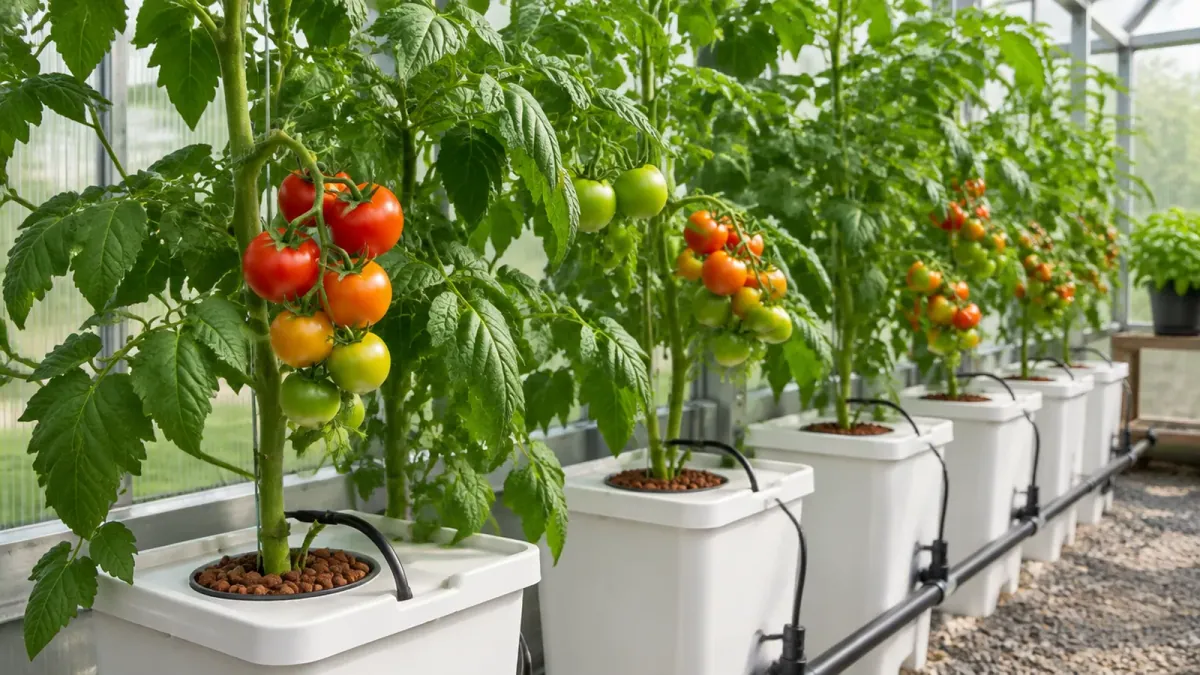
A Dutch bucket has a drain at the bottom that leaves a small pool of solution, so roots stay moist and get oxygen.
- Fill each bucket with clay pebbles or perlite.
- Connect a drip emitter from a reservoir pump to each bucket.
- Run drain lines back to the reservoir.
- Set a timer so the system waters several times a day, more often in strong light.
- Check flow daily so no emitter clogs.
Each bucket holds one plant. Use a sturdy overhead support, since a full plant with fruit is heavy.
Harvest and ripening
Tomatoes ripen about six to eight weeks after fruit set, varying by variety. Pick when fruit is fully colored and slightly soft. Hydroponic tomatoes often taste best when allowed to ripen on the vine, but pick before they split. A gentle feeding drop (slightly lower EC) in late ripening sometimes improves flavor in some varieties, though yields drop, so adjust carefully.
Frequently asked questions
Can you grow tomatoes hydroponically at home?
Yes. Tomatoes are among the most rewarding hydroponic crops, but they need more than lettuce: strong light, a large reservoir or container, regular feeding, support for vining stems and help with pollination indoors. Compact and cherry varieties are easiest. Expect fruit about two to three months after transplanting.
What is the best hydroponic system for tomatoes?
Dutch buckets (bato buckets) and other drip-fed container systems suit large indeterminate tomatoes, because each plant gets its own large root zone. Deep water culture with big buckets also works, and compact varieties can grow in simple Kratky-style or ebb-and-flow setups. Choose a system that holds plenty of medium and supports heavy plants.
What pH and nutrients do hydroponic tomatoes need?
Keep the nutrient solution at roughly pH 5.8 to 6.3, and use a nutrient formula for fruiting plants, adjusting strength by growth stage. Tomatoes usually run higher EC than lettuce, about 2.0 to 3.5 mS/cm in many guides, but follow your nutrient label. Check pH and EC often, and top up the reservoir regularly.
Do I need to pollinate tomatoes indoors?
Yes, usually. Tomato flowers self-pollinate but need vibration, which wind and insects supply outdoors. Indoors, gently shake the flower trusses or tap them each day, or use an electric toothbrush near the flowers, when blooms are open. Good airflow from a fan also helps. Without it, flowers may drop without setting fruit.
How much light do hydroponic tomatoes need?
Tomatoes are high-light plants. Indoors they need a strong, full-spectrum LED grow light, on for about 14 to 16 hours a day, set at the distance the manufacturer recommends. A sunny south window alone is rarely enough. Weak light causes leggy plants, dropped flowers and few fruit.