pH and EC for Hydroponics: A Plain-English Guide
On this page
In hydroponics, pH measures how acidic or alkaline the nutrient solution is, and EC measures how strong it is. Most crops like a pH of about 5.5 to 6.5, while EC depends on the crop: gentle for lettuce, stronger for tomatoes. Test regularly, adjust in small steps and keep your meters calibrated.
Why pH matters
pH is measured on a scale of 0 to 14. Seven is neutral, lower numbers are acidic and higher numbers are alkaline. Plants can take up nutrients only when they are dissolved and in the right chemical form, and pH controls that. If pH drifts too high or low, some nutrients such as iron, calcium and manganese become hard for roots to absorb, which leads to deficiency symptoms even though the nutrients are in the water. For more guides, visit our hydroponics hub, and see our hydroponics for beginners guide.
Why EC matters
EC tells you how concentrated the nutrient solution is. Too low and plants go hungry, with pale leaves and slow growth. Too high and roots struggle to take up water, leaves burn at the tips and growth slows. Because plants take up water and nutrients at different rates, EC rises and falls over time and needs checking.
Typical target ranges
These ranges are common guides. Your nutrient manufacturer’s chart is the best starting point.
| Crop | pH | EC (mS/cm) |
|---|---|---|
| Lettuce and leafy greens | 5.5–6.5 | About 0.8–1.5 |
| Basil and herbs | 5.5–6.5 | About 1.0–1.6 |
| Spinach and kale | 5.5–6.5 | About 1.8–2.3 |
| Strawberries | 5.5–6.2 | About 1.0–1.5 |
| Peppers | 5.8–6.3 | About 2.0–3.5 |
| Tomatoes | 5.8–6.3 | About 2.0–3.5 |
| Cucumbers | 5.8–6.2 | About 1.7–2.5 |
Seedlings and cuttings need weaker solutions, often half strength or less. See our guides to hydroponic lettuce and hydroponic tomatoes for crop-specific details.
EC, TDS and PPM
| Term | Meaning | Note |
|---|---|---|
| EC | Electrical conductivity, in mS/cm or dS/m | The direct measurement |
| TDS | Total dissolved solids | Estimated from EC |
| PPM | Parts per million | Same as TDS; depends on the conversion scale |
| CF | Conductivity factor (EC × 10) | Used in some countries |
Meters use different conversion scales (commonly 0.5 or 0.7). A reading of 1.4 mS/cm may display as 700 ppm on one meter and 980 ppm on another. Choose one scale, and use the same meter and unit all the time.
Tools you need
- pH meter or test kit. Digital pens give a quick, precise reading; liquid test kits are cheap but less exact; paper strips are the least accurate.
- EC or TDS meter. A digital pen is the easiest option.
- Calibration solutions. Buffer solutions at pH 7.0 and 4.0 (or 4.0 and 10.0) for pH meters, and a conductivity standard for EC meters.
- pH up and pH down. Hydroponic-grade adjusters.
- Clean cups and distilled water for rinsing.
- Gloves and eye protection for handling pH adjusters.
How to test
- Mix the nutrient solution first, then wait a few minutes for it to settle.
- Rinse the probe with clean water.
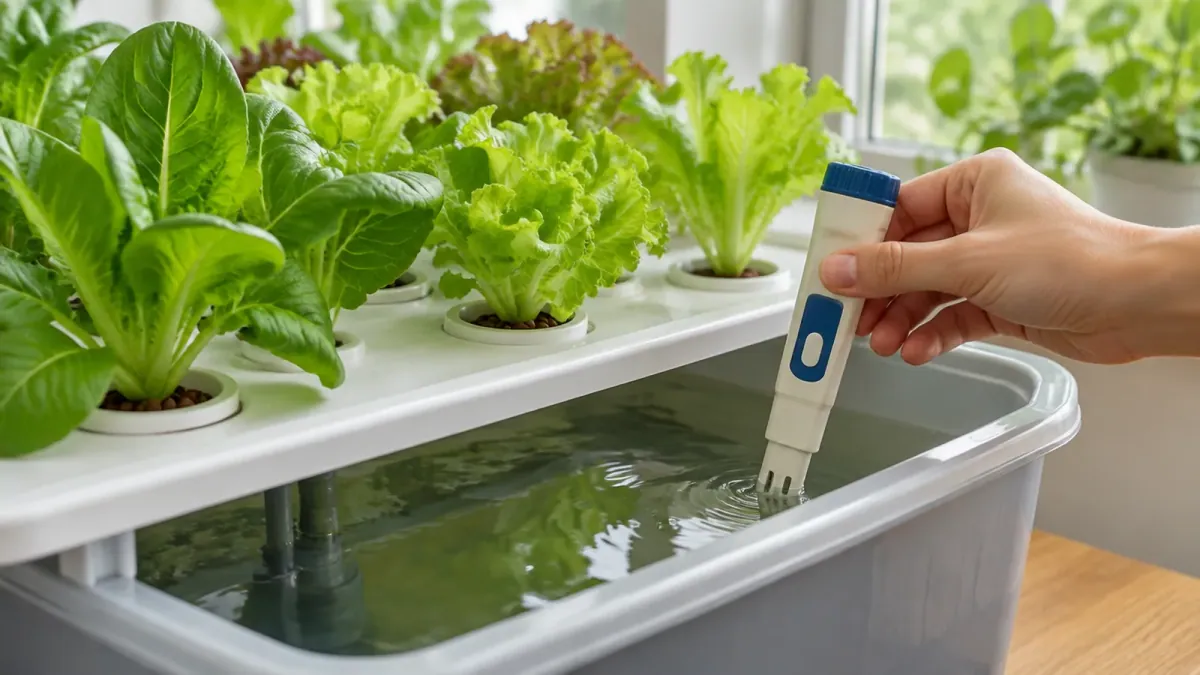
- Dip it in the reservoir, stir gently and wait for a stable reading.
- Record the numbers in a notebook or app.
- Rinse and store probes as the manufacturer advises (pH probes need storage solution, not dry storage).
How to adjust pH
- Test the solution. Note the pH and your target.
- Add a small amount of pH down (to lower) or pH up (to raise). Start with a few drops or a quarter teaspoon in a large reservoir.
- Mix well and wait 10 to 15 minutes.
- Recheck, and repeat if needed.
- Don’t overshoot. Swinging up and down stresses plants.
Always add acid or base to water and never the other way around, wear gloves and eye protection, and store adjusters safely away from children and pets. Hard tap water often has high alkalinity, so pH rises quickly; you may need more pH down, or use filtered or reverse-osmosis water.
How to adjust EC
| Reading | What to do |
|---|---|
| EC too low | Add more nutrient solution gradually, mixed according to the label |
| EC too high | Add plain water to dilute |
| EC rising quickly | Plants may be drinking more water than nutrients; add plain water |
| EC dropping quickly | Plants are using nutrients quickly; top up with nutrient solution |
Change the whole reservoir regularly, because ratios of nutrients drift over time.
Calibrating meters
Meters drift, and old or dirty probes give wrong readings. Calibrate pH meters every few weeks, or more often with heavy use, using fresh buffer solutions. Calibrate EC meters with a standard solution. Replace pH probes when they respond slowly or can’t calibrate, usually after a year or two.
What affects pH and EC
| Factor | Effect |
|---|---|
| Plant uptake | Changes both over days |
| Water source | Hard water raises pH and EC; very soft water is less stable |
| Temperature | Warm water changes readings; measure at room temperature |
| Reservoir size | Large reservoirs are more stable |
| Growing medium | Some media, such as coco, can buffer pH |
| Algae and bacteria | Can shift pH |
Troubleshooting with pH and EC
| Symptom | Possible cause | What to check |
|---|---|---|
| Yellow new leaves | Iron locked out by high pH | Test and lower pH |
| Pale old leaves | Nitrogen shortage or low EC | Check EC |
| Burned leaf tips | EC too high | Dilute |
| Slow growth | Low EC or wrong pH | Test both |
| Brown roots | Warm water, low oxygen | Cool and aerate; not just pH |
| pH swings constantly | Dirty probe, small reservoir, hard water | Calibrate; use a larger reservoir; filter water |
A simple daily routine
| Task | When |
|---|---|
| Check water level and top up | Daily |
| Test pH | Every 2–3 days |
| Test EC | Weekly and after topping up |
| Change the reservoir | Every 1–2 weeks |
| Calibrate meters | Every few weeks |
| Clean the system | Between crops |
For ready-made routines, see our guide to hydroponic nutrients.
Pets and safety
pH up, pH down and nutrient concentrates can irritate skin, eyes and, if swallowed, the stomach. Keep them in labeled containers away from children and pets, and keep nutrient reservoirs covered.
Frequently asked questions
What is the ideal pH for hydroponics?
Most hydroponic crops grow well with a nutrient solution pH of about 5.5 to 6.5, with 5.8 to 6.2 a common target. Within that window, plants can take up most nutrients. Outside it, some nutrients become less available, which can cause deficiencies even when nutrients are present. Check the pH of your solution regularly and adjust slowly.
What is EC in hydroponics?
EC, or electrical conductivity, measures how much dissolved salt is in the nutrient solution, so it indicates nutrient strength. It is usually shown in mS/cm. A higher EC means a stronger solution. Different crops and growth stages need different EC levels, and your nutrient label should give a starting range.
What is the difference between EC, TDS and PPM?
EC is the direct measurement of conductivity. TDS (total dissolved solids) and PPM (parts per million) are estimates calculated from EC using a conversion factor, commonly 0.5 or 0.7, depending on the meter. Because the factor differs, the same solution can read as different PPM values on different meters. Pick one scale and stay with it.
How do I lower or raise pH in hydroponics?
Use a pH down product (usually an acid such as phosphoric acid) to lower pH, and pH up (usually a base such as potassium hydroxide or bicarbonate) to raise it. Add small amounts, mix well and recheck after a few minutes. Wear gloves and eye protection, and keep products away from children and pets.
How often should I check pH and EC?
In a new system, check pH daily until you see how fast it drifts, then every two to three days. Check EC at least weekly, and always when topping up or changing the reservoir. Large reservoirs are more stable than small ones. Calibrate your meters regularly, because inaccurate readings cause more problems than almost anything else.