Hydroponic Nutrients: What Plants Need and How to Mix Them
On this page
Hydroponic nutrients are complete fertilizer formulas that supply every element plants need, dissolved in water. Plants need macronutrients such as nitrogen, phosphorus, potassium, calcium and magnesium, plus trace micronutrients. Use a nutrient made for hydroponics, mix it exactly as the label says, keep pH around 5.5 to 6.5, and replace the solution every two to three weeks.
Why hydroponics needs special nutrients
In soil, plants take some nutrients from decomposing organic matter, clay and minerals. In hydroponics, there is none of that, so everything must be in the water. A hydroponic nutrient is balanced to supply all the elements plants need in forms that dissolve cleanly and stay available. For the basics of the whole approach, see our guide to hydroponics for beginners, and browse our hydroponics hub for more.
What plants need
Macronutrients
| Nutrient | What it does | Deficiency sign |
|---|---|---|
| Nitrogen (N) | Leaf and stem growth; chlorophyll | Pale, yellow older leaves |
| Phosphorus (P) | Roots, flowers and fruit | Dark or purple-tinged leaves; slow growth |
| Potassium (K) | Overall health; fruit quality | Brown, scorched leaf edges |
| Calcium (Ca) | Cell walls; new growth | Distorted new leaves; tip burn in lettuce |
| Magnesium (Mg) | Chlorophyll | Yellowing between veins on older leaves |
| Sulfur (S) | Proteins and flavor | Pale new leaves |
Micronutrients
Iron, manganese, zinc, copper, boron and molybdenum are needed in tiny amounts, but without them plants suffer. Iron deficiency, for instance, shows as yellow new leaves with green veins, often caused by high pH locking it out rather than a lack of iron.
Types of hydroponic nutrients
| Type | What it is | Pros | Cons |
|---|---|---|---|
| One-part complete | One bottle or powder with everything | Simplest; good for beginners | Less flexible for specific crops |
| Two-part (A and B) | Separate parts to keep calcium away from sulfates and phosphates | Stable and flexible | Must be added in the right order |
| Three-part (grow, micro, bloom) | Separate formulas for growth and flowering | Fine-tuning for fruiting crops | More complicated |
| Powder vs liquid | Dry salts or liquid concentrates | Powders last longer and cost less; liquids are convenient | Powders need careful dissolving |
| Organic hydroponic | Derived from natural sources | Appeals to organic growers | Can be messy, smelly and prone to clogging |
| Lettuce or leafy-green formulas | Higher in nitrogen and calcium | Good for greens and herbs | Not ideal for fruiting crops |
For a beginner with lettuce or herbs, a one-part or two-part complete formula is the easy choice.
How to choose a nutrient
- Match it to your crop. Greens like leafy formulas; tomatoes and peppers benefit from bloom formulas at flowering.
- Make sure it is complete. It should supply calcium, magnesium and micronutrients, not only NPK.
- Check compatibility with your water. Hard water already contains calcium and magnesium, so some manufacturers offer formulas for hard or soft water.
- Consider your system. Fine tubing and drip emitters clog with sediment, so choose well-dissolving formulas.
- Follow the label. Nutrient makers publish feeding schedules and EC or ppm targets.
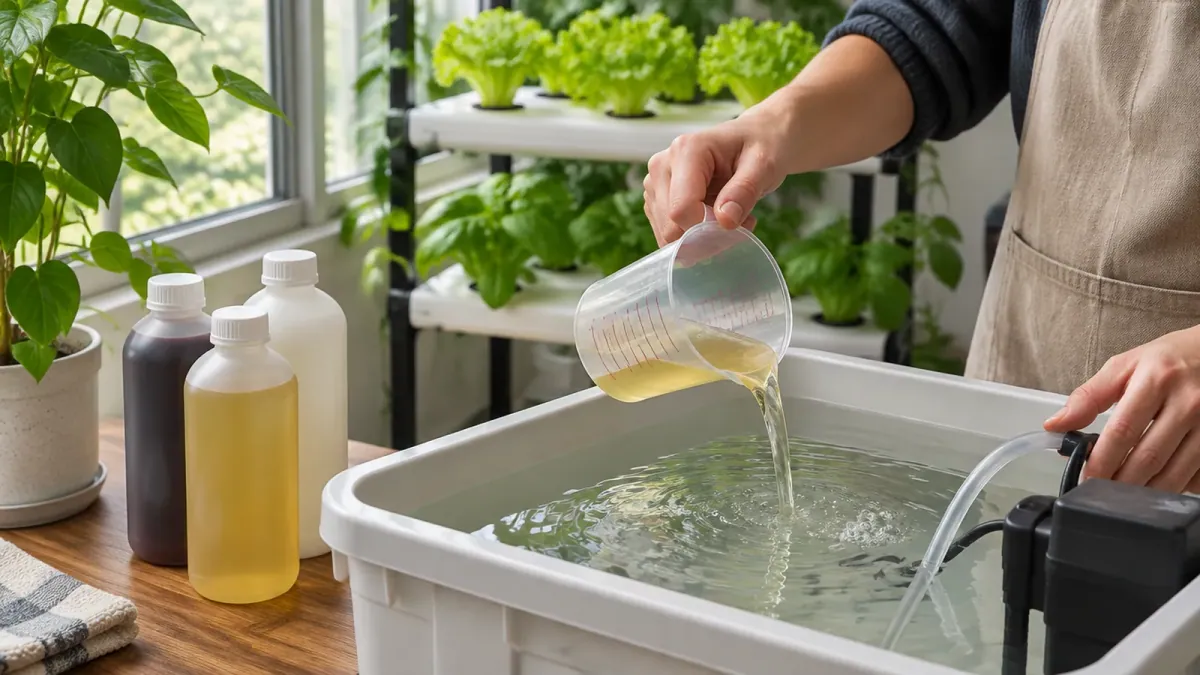
How to mix a hydroponic solution
- Start with clean water at room temperature. Let chlorinated tap water sit if advised.
- Add nutrients in the order on the label, and stir. In two-part systems, add part A, stir, then part B. Never mix undiluted concentrates together.
- Measure EC (or ppm) and compare it to the target.
- Measure pH and adjust to about 5.5 to 6.5 using small amounts of pH down or up, stirring and rechecking.
- Pour into the reservoir and check again after an hour.
Our guide to pH and EC for hydroponics explains these measurements in more detail.
Typical strength by crop
These are general guides for beginners. Always check your nutrient maker’s recommendations.
| Crop | Typical EC (mS/cm) | Typical pH |
|---|---|---|
| Seedlings | About 0.5–1.0 | 5.5–6.0 |
| Lettuce and leafy greens | About 0.8–1.4 | 5.5–6.5 |
| Herbs (basil, mint) | About 1.0–1.6 | 5.5–6.5 |
| Strawberries | About 1.0–1.4 | 5.5–6.2 |
| Tomatoes and peppers (fruiting) | About 2.0–3.5 | 5.8–6.3 |
| Cucumbers | About 1.7–2.5 | 5.5–6.0 |
Maintaining the solution
- Top up with plain water as plants drink, since they drink more water than nutrients. Top up with nutrient solution only if EC drops too far.
- Check pH every few days. pH drifts as plants take up nutrients.
- Replace the whole reservoir every two to three weeks, or sooner in small, warm reservoirs.
- Keep it cool and dark to prevent algae and root rot.
- Clean the reservoir at each change with a mild, food-safe cleaner and rinse well.
Signs of nutrient problems
| Symptom | Likely cause | Fix |
|---|---|---|
| Pale new leaves | Low nutrients or iron lockout | Check pH and EC; refresh solution |
| Yellow older leaves | Low nitrogen or magnesium | Check EC; adjust feed |
| Brown, burnt tips | Solution too strong | Dilute with plain water |
| Tip burn in lettuce | Calcium shortage, fast growth, heat | Improve airflow; keep cooler; check calcium |
| Purple tints | Low phosphorus or cold roots | Warm the root zone; check feed |
| Stunted growth | pH out of range or low light | Check pH; check light |
Water quality and hydroponic nutrients
Your tap water affects your nutrient solution. Very hard water already contains calcium and magnesium, so you may need less of those in the formula, and it can push pH up. Soft water starts with almost no minerals, so a complete nutrient with added calcium and magnesium is needed. Chlorine usually isn’t a problem for plants, but chloramine can be, and filtered or reverse-osmosis water gives you a clean starting point. If you are unsure, test your tap water’s EC and pH before you add anything, and compare the result with the readings after mixing.
Nutrients for different growth stages
| Stage | What plants need | Typical approach |
|---|---|---|
| Seedling | Gentle feeding; low strength | Quarter to half-strength solution |
| Vegetative growth | Plenty of nitrogen for leaves | Full-strength grow formula |
| Flowering and fruiting | Less nitrogen; more phosphorus and potassium | Switch to a bloom formula |
| Late fruiting | Steady potassium and calcium | Maintain strength; watch for deficiencies |
Leafy crops such as lettuce stay in the vegetative stage and don’t need a bloom formula, which keeps nutrition simple for beginners. For fruiting crops, see our guide to hydroponic tomatoes.
Common nutrient mistakes
- More isn’t better. Overfeeding burns roots and tips.
- Ignoring pH. Nutrients are locked out when pH is far off range, even if the solution is full.
- Using hard water without adjusting. It may already contain calcium and magnesium.
- Mixing concentrates directly. They can react and form precipitates that plants cannot use.
- Skipping changes. Salts and imbalances build up over weeks.
- Warm solutions. They encourage disease. See our guide to the Kratky method for a simple system where temperature control matters.
Storing and handling nutrients
Store concentrates in a cool, dark place, tightly capped, and away from children and pets. Wear gloves when handling strong acids used for pH adjustment, and never mix acids with other chemicals. Label every container, use dedicated measuring tools and dispose of old solution sensibly: diluted used solution can often be used to water outdoor plants, but check local rules for large volumes.
Frequently asked questions
What nutrients do hydroponic plants need?
Hydroponic plants need the same elements as soil plants: macronutrients (nitrogen, phosphorus, potassium, calcium, magnesium, sulfur) and micronutrients (iron, manganese, zinc, copper, boron, molybdenum, chlorine and nickel). Hydroponic nutrient formulas supply all of them, dissolved in water in forms plants can absorb. Soil fertilizers often lack calcium, magnesium or trace elements.
Can I use regular plant fertilizer for hydroponics?
Usually not. Most soil fertilizers lack calcium, magnesium and micronutrients, which soil normally provides, and some contain ingredients that don’t dissolve cleanly or that clog systems. Organic fertilizers can also encourage bacteria and cause smells. Use a nutrient made for hydroponics, labeled as a complete formula.
How often should I change hydroponic nutrient solution?
A common rule is to replace the whole reservoir every two to three weeks, topping up with plain water in between and adjusting pH. Small reservoirs and heavy feeders may need changes more often. Changing regularly prevents salts and imbalances from building up. Follow your nutrient manufacturer’s advice as well.
What are the signs of nutrient deficiency in hydroponics?
Nitrogen shortage causes pale, yellow older leaves. Calcium shortage causes distorted new growth and tip burn in lettuce. Magnesium shortage causes yellowing between veins on older leaves. Iron shortage causes yellow new leaves with green veins. Since pH also affects uptake, check pH before adding more nutrients.
What is EC and why does it matter?
EC, electrical conductivity, measures how many dissolved salts, mostly nutrients, are in your water. A higher EC means a stronger solution. Leafy greens typically like a lower EC than fruiting plants. Measuring EC shows whether you are feeding too much or too little. Use your nutrient maker’s recommended range as a starting point.