Hydroponics for Beginners: How It Works and How to Start
On this page
Hydroponics grows plants without soil, with roots supplied by water containing dissolved nutrients. To start, choose a simple system such as the Kratky method, a deep water culture tote or a countertop kit, grow lettuce or basil, use hydroponic nutrients, keep pH around 5.5 to 6.5, and give indoor plants 14 to 16 hours of light a day.
What is hydroponics?
Hydroponics means growing plants in water-based nutrient solutions instead of soil. Plants don’t need soil itself, only the water, nutrients, oxygen and support it provides. Remove the soil, deliver those essentials directly, and plants can grow quickly in less space. Hydroponics is used from home herb kits to commercial greenhouses.
Home growers choose it to grow herbs and salads indoors all year, to grow food without soil or outdoor space, and to avoid soil pests. It has trade-offs: equipment, electricity and regular testing. For more guides, visit our hydroponics hub.
How hydroponics works
Every hydroponic system provides four things:
- Water and nutrients. A reservoir holds water with dissolved nutrients: nitrogen, phosphorus, potassium, calcium, magnesium and trace elements. Our guide to hydroponic nutrients explains what is in them.
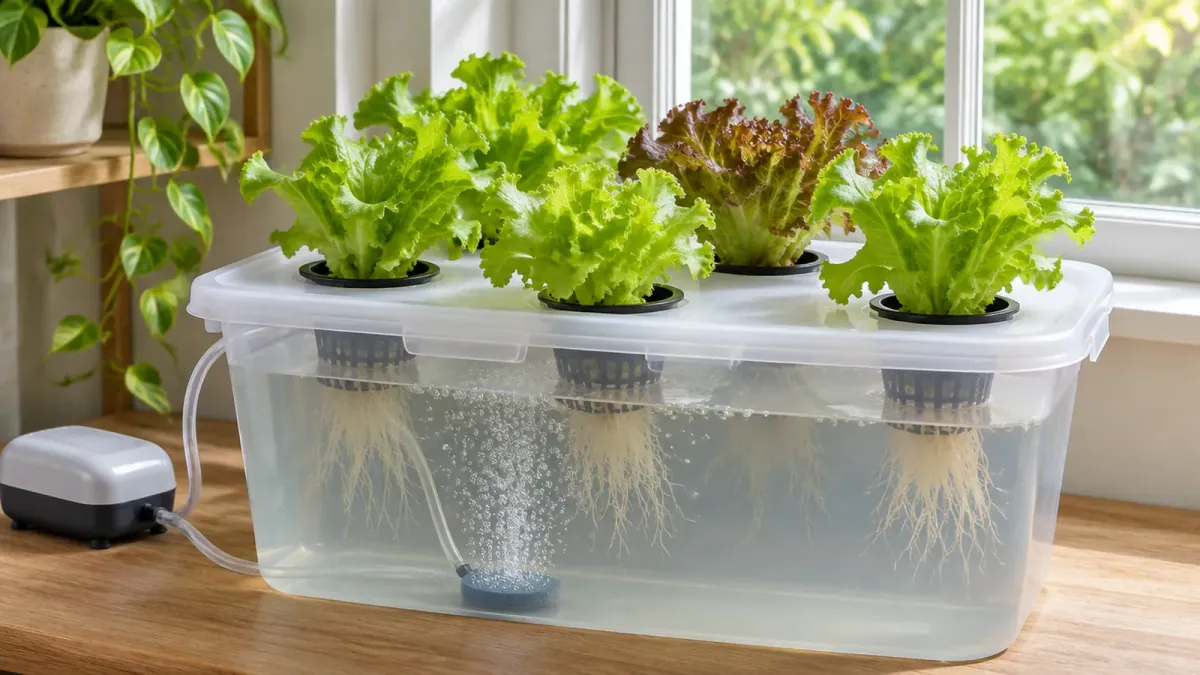
- Oxygen. Roots need air as well as water. Air pumps and air stones, flowing water, or an air gap above the water supply it.
- Support. Plants sit in net pots, plugs or media such as clay pebbles, coir or rockwool.
- Light. Indoors, a grow light replaces the sun.
The right pH keeps nutrients available. Most crops do best between about 5.5 and 6.5. Our guide to pH and EC for hydroponics explains the numbers.
Pros and cons
| Pros | Cons |
|---|---|
| Grow indoors all year | Equipment and electricity costs |
| No soil, weeds or soil pests | Needs regular pH and nutrient checks |
| Fast growth for greens and herbs | Pump failure can harm plants quickly |
| Uses water efficiently in recirculating systems | Not suited to every crop |
| Clean and compact | Learning curve |
Types of hydroponic systems
| System | Pump? | Best for | Beginner-friendly? |
|---|---|---|---|
| Kratky (passive) | No | Lettuce, herbs | Yes |
| Wick | No | Small herbs | Yes |
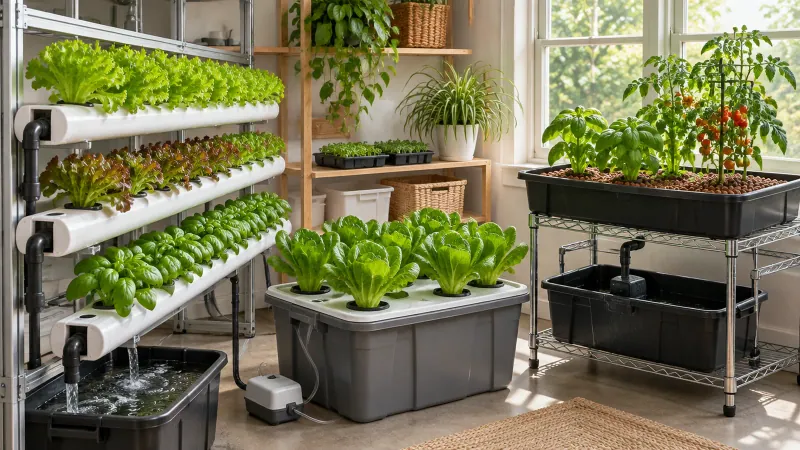
| Deep water culture (DWC) | Air pump | Lettuce, herbs, some fruiting plants | Yes |
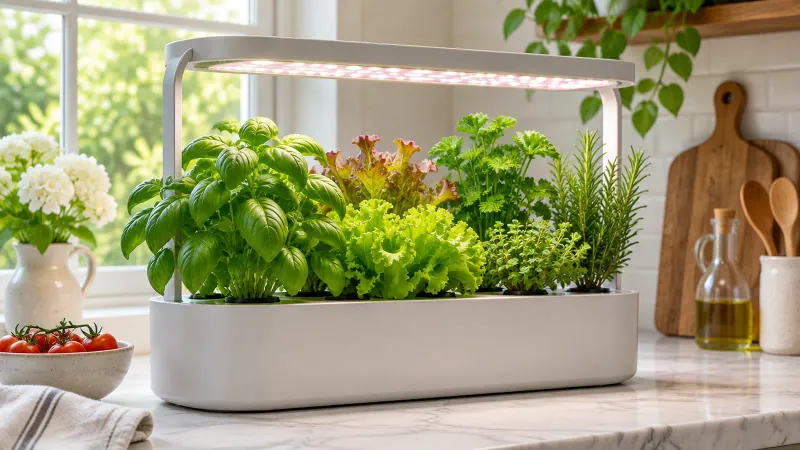
| Countertop smart garden | Built in | Herbs, greens | Yes |
| Ebb and flow | Water pump + timer | Many crops | Moderate |
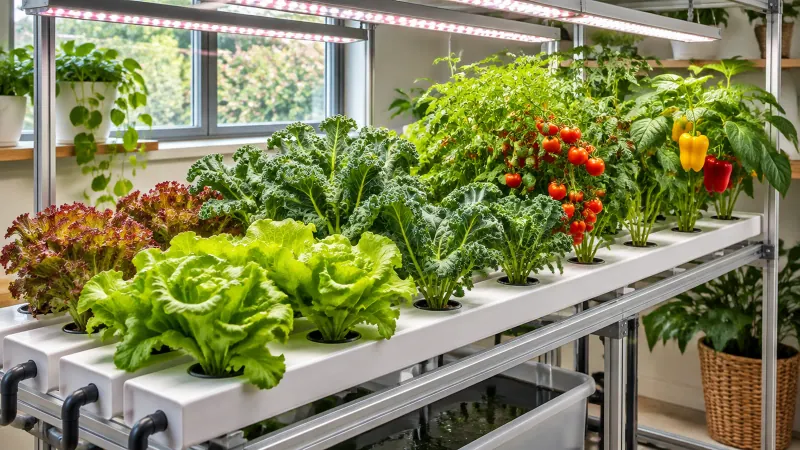
| Drip | Water pump + timer | Tomatoes, peppers | Moderate |
| NFT | Water pump | Lettuce, herbs in quantity | Moderate |
| Aeroponics | High-pressure pump | Advanced growers | No |
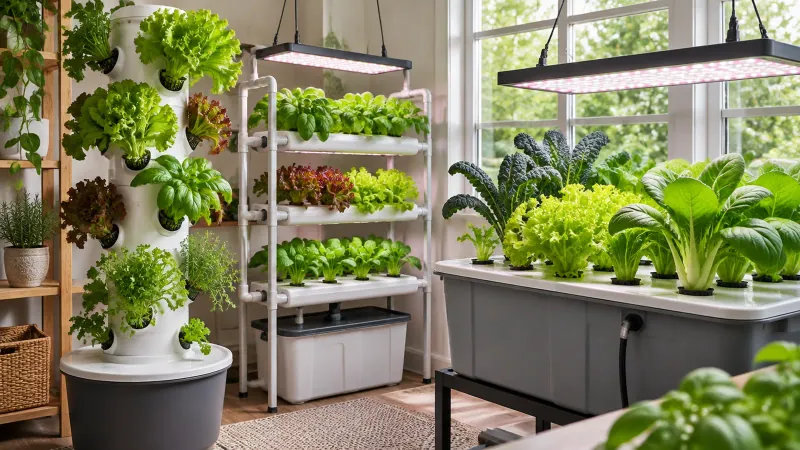
Our guide to types of hydroponic systems explains each method, and our comparison of the best hydroponic growing systems helps you choose. If you prefer a ready-made kit, see our guide to the best indoor hydroponic garden.
What you need to start
- A system or container. Opaque, food-safe containers prevent algae.
- Net pots and a lid, or a kit with planting sites.
- Growing medium: rockwool cubes, coir plugs, clay pebbles or perlite.
- Hydroponic nutrients. Use a formula made for hydroponics, not soil fertilizer.
- A pH test kit or meter, and ideally an EC (nutrient strength) meter.
- A grow light and timer if indoors.
- An air pump and air stone for deep water culture.
- Seeds or seedlings. Start with lettuce or basil.
Best beginner crops
| Crop | Difficulty | Time to harvest | Notes |
|---|---|---|---|
| Lettuce | Easy | 4–6 weeks | Loose-leaf is fastest; keep the solution cool |
| Basil | Easy | 4–6 weeks | Pinch tips; warm and well lit |
| Mint | Easy | 4–6 weeks | Vigorous; give it its own system |
| Arugula and chard | Easy | 3–6 weeks | Fast; bolt in heat |
| Spinach | Moderate | 5–7 weeks | Prefers cool conditions |
| Strawberries | Harder | 8+ weeks | Need pollination and strong light |
| Tomatoes and peppers | Harder | 2–4 months | Need big systems, support and hand pollination |
Our guides to hydroponic lettuce and hydroponic tomatoes cover popular crops in detail.
How to start: a simple first system
The easiest way to learn is a Kratky jar or small deep water culture tote. For a basic lettuce setup:
- Choose an opaque container with a lid, such as a food-safe tote or bucket.
- Cut holes in the lid the size of your net pots, spaced for the crop (about 6 to 8 inches apart for lettuce).
- Start seeds in rockwool or coir plugs, kept moist and warm, until roots appear.
- Mix nutrient solution following the label, with water at room temperature.
- Adjust pH to about 5.5 to 6.5.
- Place seedlings in net pots with the roots just touching the water.
- Set the light for 14 to 16 hours a day if indoors, 6 to 12 inches above leafy plants, depending on the light.
- Top up and change the solution as plants grow, every two to three weeks.
For a step-by-step version with no pump, see our guide to the Kratky method, and for building your own system, see our guide to a DIY hydroponic system.
Light
Indoors, light decides how well plants grow. Leafy greens and herbs grow well under a moderate full-spectrum LED, while fruiting plants need much stronger light. Run lights on a timer for 14 to 16 hours daily for leafy crops. Our guide to grow lights for indoor plants explains what to look for.
Water, temperature and oxygen
- Water temperature: keep it around 65 to 75°F. Warm water holds less oxygen and encourages root rot.
- Oxygen: use an air stone in DWC, and keep an air gap in Kratky jars.
- Water quality: most tap water is fine; very hard water or softened water can cause problems.
- Light-proof reservoirs: algae grows wherever light hits nutrient solution.
Your first month: week by week
| Week | What to do |
|---|---|
| 1 | Set up the system; rinse parts; mix nutrients; adjust pH; sow seeds in plugs |
| 2 | Keep plugs moist and warm; check light timer; don’t add nutrients until true leaves appear if the label says to wait |
| 3 | Move seedlings into the system once roots show; check pH and water level every few days |
| 4 | First light harvests of baby greens or herbs; top up with plain water; plan the first full solution change |
Keep a simple log of dates, pH readings and solution changes. After a few cycles, patterns appear and troubleshooting gets much faster.
Hydroponics vs soil
| Factor | Hydroponics | Soil |
|---|---|---|
| Setup | Equipment needed | Minimal |
| Growth speed (greens) | Often faster | Slower |
| Water use | Low in recirculating systems | Higher |
| Space | Compact, indoors | Needs garden or large pots |
| Skill | pH and nutrient management | Soil and weather management |
| Failure risk | Pump or power failure | Weather, pests, soil disease |
| Cost per pound of food | Usually higher at home | Usually lower |
Troubleshooting: what plants are telling you
| Symptom | Likely cause | Fix |
|---|---|---|
| Pale, yellow new leaves | Solution too weak or pH off | Check pH; refresh solution |
| Brown, crispy leaf tips | Solution too strong | Dilute with plain water |
| Slimy brown roots | Warm, low-oxygen water | Clean system; cool the reservoir; add aeration |
| Green algae | Light reaching the solution | Cover holes; use opaque containers |
| Tall, floppy seedlings | Light too weak or far | Lower the light; lengthen the day |
| Wilting despite full reservoir | Root damage or pump failure | Check pump and roots |
Hydroponic words you will meet
- EC: electrical conductivity, a measure of nutrient strength.
- Net pot: a small mesh pot that holds a plant above the solution.
- Reservoir: the tank holding the nutrient solution.
- Medium: the inert material that supports roots, such as clay pebbles or rockwool.
- Bolt: when a plant flowers early, usually from heat stress, and quality declines.
Common beginner mistakes
| Mistake | Result | Fix |
|---|---|---|
| Using soil fertilizer | Missing nutrients; poor growth | Use a complete hydroponic nutrient |
| Ignoring pH | Nutrient deficiency symptoms | Test weekly; adjust gently |
| Too little light | Tall, weak plants | Use a proper grow light on a timer |
| Warm reservoir | Root rot, slime | Keep it cool, dark and aerated |
| Overcrowding | Competition; poor airflow | Space plants as the label advises |
| Starting too big | Overwhelmed, wasted money | Begin with one small system |
| Skipping cleaning | Algae and disease | Clean thoroughly between crops |
What does hydroponics cost?
Costs vary by system, so here are general ranges rather than prices. A Kratky or bucket system built from simple containers is among the cheapest ways to start; countertop kits cost more but include lights; large towers and multi-tier systems cost the most. Ongoing costs are nutrients, electricity for lights and pumps, and seeds or pods. Starting with one cheap system and an easy crop teaches the basics before you invest more.
Safety and cleanliness
Hydroponics mixes water and electricity, so keep sockets, timers and pump plugs well above water, use drip loops in cords and plug into a GFCI outlet where possible. Wash hands before handling plants, rinse harvested leaves, and clean reservoirs between crops with a mild, food-safe cleaner followed by a thorough rinse. Store nutrient concentrates away from children and pets, and never mix different concentrates together before diluting them.
Is hydroponics worth it?
If you want a steady supply of fresh herbs and greens, have limited space, or enjoy tinkering, yes. If you want large quantities of food cheaply, soil gardening is usually cheaper; see our guide to vegetable gardening for beginners. Many home growers do both: soil outside in summer, hydroponics inside in winter.
Frequently asked questions
How does hydroponics work?
Hydroponics grows plants without soil. Roots sit in, or are regularly flooded with, water containing dissolved nutrients, and are held in an inert medium such as clay pebbles, rockwool or coir. A pump or air stone supplies oxygen, and indoors a grow light replaces the sun. Because roots get water, nutrients and oxygen directly, plants such as lettuce and herbs can grow quickly.
What do I need to start hydroponics at home?
At minimum: a container or system, a way to hold plants (net pots or a lid), a growing medium, hydroponic nutrients, seeds or seedlings and, indoors, a grow light on a timer. A pH test kit or meter is strongly recommended, and an air pump helps in water-based systems. A complete countertop kit bundles most of these.
What is the easiest hydroponic system for beginners?
The Kratky method needs no pumps or electricity and suits lettuce and herbs. A deep water culture tote with an air pump is also simple and forgiving. Countertop kits with built-in lights are the easiest to start with. Avoid NFT and aeroponics at first, since pump failures can quickly harm roots.
What can you grow with hydroponics?
Leafy greens and herbs grow best: lettuce, spinach, kale, chard, arugula, basil, mint, parsley and cilantro. Strawberries, tomatoes, peppers and cucumbers are possible in larger setups with strong lights and support. Root crops such as potatoes and carrots are poorly suited to home systems. Start with lettuce or basil.
Is hydroponics expensive to start?
It can be cheap or costly. A simple Kratky jar or bucket system can cost very little, while countertop kits and large indoor towers cost much more, plus ongoing costs for nutrients, electricity and seeds or pods. Starting small with an easy crop lets you learn before spending on more equipment.