Grow Lights for Indoor Plants: How to Choose the Right One
On this page
The right grow light for indoor plants is usually a full-spectrum LED matched to what your plants need: low-light foliage plants need little, while herbs, succulents, seedlings and flowering plants need stronger, closer light on a timer. Check the light’s output (PPFD), the area it covers and its spectrum, not just watts or marketing claims.
Do your plants need a grow light?
Plants use light to make food, and indoor light is much weaker than outdoor light. Even a bright windowsill may provide only a fraction of full sun, and winter days are short. Signs that a plant needs more light include long, stretched stems, small pale leaves, leaning toward the window, lost variegation and no flowers or fruit.
| Plant need | Typical examples | Light solution |
|---|---|---|
| Low light | Snake plant, ZZ plant, pothos | Window light or a modest bulb |
| Medium light | Philodendron, peace lily, dracaena | Bright window or a medium light |
| High light | Succulents, cacti, citrus, herbs, fiddle leaf fig | Strong grow light, close and on a timer |
| Seedlings and cuttings | Vegetables, herbs, flowers | Bright light close above plants |
| Flowering and fruiting | Orchids, tomatoes, peppers | Powerful, full-spectrum, longer coverage |
For plants that survive in dim rooms, see our guide to low-light indoor plants. For more indoor plant guides, visit our indoor plants hub.
Types of grow lights
LED grow lights
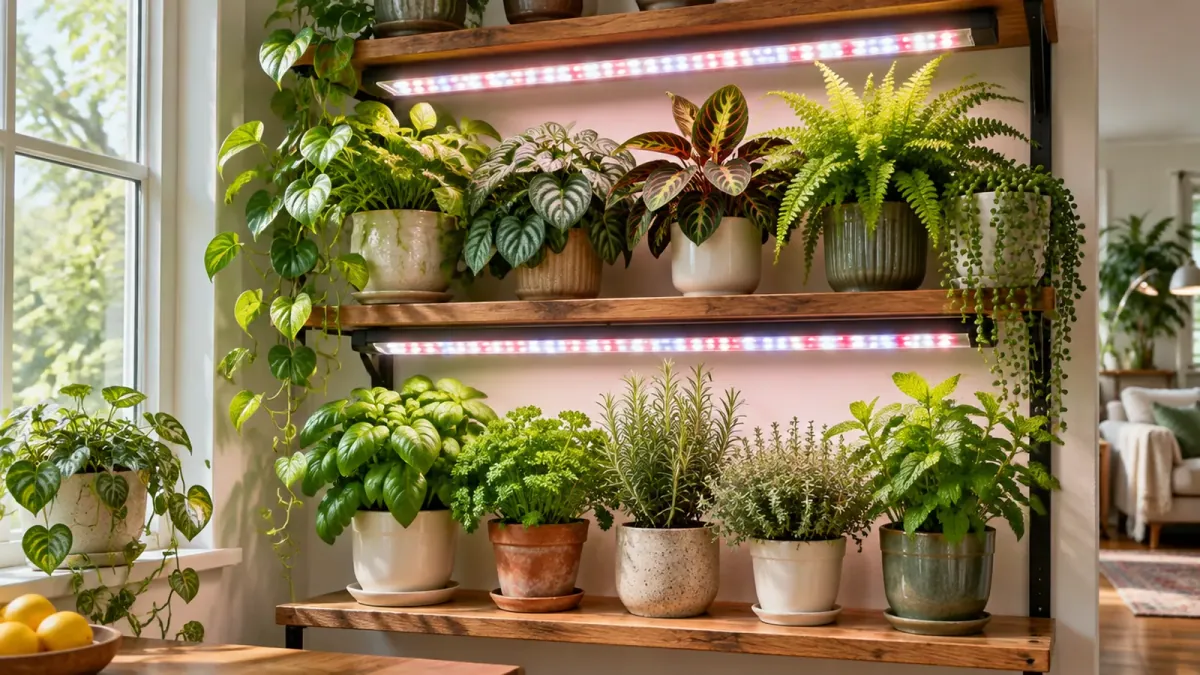
LEDs are the standard choice. They use little electricity for the light they produce, run relatively cool and last for many years. They come as bulbs, bars, strips, panels and clip-on lamps. Quality varies widely, so judge by specs, not by looks.
Fluorescent (T5 and T8) tubes
Fluorescent tubes are inexpensive and give even, gentle light over a shelf. T5 high-output tubes are better than older T8 types. They’re a good fit for seedlings, leafy greens and herbs on a rack, though they are less efficient than LEDs and the tubes lose output over time.
Compact fluorescent (CFL) bulbs
CFL bulbs fit ordinary lamps and are fine for small plants, but they are weaker than most dedicated lights and best for low-demand uses.
Incandescent and halogen
These produce mostly heat and little useful light, and are a poor choice. They can scorch leaves.
HID (metal halide and high-pressure sodium)
HID lamps produce very strong light but also heat, noise and high energy use. They are for large, serious growers rather than houseplants.
| Type | Efficiency | Heat | Best for | Drawbacks |
|---|---|---|---|---|
| LED | High | Low | Almost everything | Quality varies |
| T5 fluorescent | Moderate | Low to moderate | Shelves, seedlings, herbs | Tubes dim over time |
| CFL | Moderate | Moderate | Small plants | Weak |
| Incandescent | Low | High | None | Wasteful, can burn plants |
| HID | Moderate to high | High | Large operations | Hot, bulky, costly to run |
How to read the specs
Marketing words are not specs. These terms tell you what a light really delivers.
| Term | What it means | Why it matters |
|---|---|---|
| PPF (µmol/s) | Total light output the plant can use | Compares overall light output |
| PPFD (µmol/m²/s) | Light intensity reaching the plant at a given distance | The best guide to whether plants get enough light |
| Efficacy (µmol/J) | Light produced per unit of energy | Shows how efficiently the light uses power |
| Spectrum | Mix of wavelengths | Full-spectrum white is a safe default |
| Color temperature (K) | Warm to cool white | Cooler (5000–6500K) suits leafy growth, warmer suits flowering |
| CRI | How natural colors look | Higher is easier on the eyes |
| Wattage | Power drawn, not light produced | Compare only with other data |
| Coverage area | The area the light can cover at a given height | Prevents buying a light that is too small |
Ask for a PPFD map from the manufacturer showing light levels at set heights. Be cautious with claims such as “equal to a 1000-watt bulb”, and with photos of plants that cannot be checked.
How much light do plants need?
Plants need different amounts of light, often described as daily light integral (DLI), the total light received in a day. In general:
| Plant group | Light demand |
|---|---|
| Low-light foliage (snake plant, ZZ, cast iron) | Low |
| Tropical foliage (pothos, monstera, philodendron) | Low to medium |
| Herbs and leafy greens | Medium to high |
| Succulents and cacti | High |
| Flowering plants and fruiting vegetables | High to very high |
If a manufacturer gives guidance by plant type, use it, and treat any such guidance as a starting point and adjust by observing plants.
Choosing a light: criteria checklist
- What are you growing? Seedlings, leafy plants and flowers need more light than shade-tolerant foliage.
- How large is the area? Check coverage at your set height, and avoid single small bulbs for several plants.
- What form fits the space? Bulbs fit existing lamps, bars and strips suit shelves, panels suit larger areas, and clip-on or gooseneck lamps suit a single plant.
- What spectrum? Full-spectrum white is the easy default.
- Is the output stated clearly? Look for PPF or PPFD, not only watts.
- Does it have a timer or dimmer, or can you add a plug-in timer?
- How hot does it get? LEDs run cooler; check heat near leaves.
- Is it safe? Look for recognized electrical safety certification and good build quality, especially near water.
- How easy is mounting? Adjustable height or hanging kits matter.
- What is the total cost? Consider running costs, bulb replacement and durability, not just the purchase price.
Price tiers in general terms
Basic screw-in bulbs and clip-on lamps sit at the low end and suit one or two plants. Mid-range bar lights and shelf kits suit seed starting and herbs. Larger, high-output panels cost more and suit big collections or flowering plants. More expensive does not always mean better; compare light output and coverage rather than price alone.
Matching a light to your situation
| Situation | What to look for |
|---|---|
| One or two plants in a dim corner | A single bulb or clip-on lamp with a timer |
| A shelf of seedlings or herbs | Linkable LED bars or T5 fixtures hung a few inches above |
| A kitchen herb garden | Compact full-spectrum panel or gooseneck lamp; see best herbs to grow indoors |
| Large floor plant | Overhead bulb in a floor or ceiling fixture, stronger output |
| Hydroponic setup | Output matched to the crop; see hydroponics for beginners |
| Windowless room | A stronger panel and a timer; foliage plants only |
Setting up your lights
- Height: follow the manufacturer’s guidance; raise lights as plants grow.
- Timer: run 12 to 16 hours for most plants, with a dark period.
- Coverage: keep plants within the lit area; rotate plants weekly.
- Reflective surfaces: white walls or reflective film help.
- Ventilation: keep air moving, and watch temperatures.
- Electrical safety: keep plugs, timers and cords away from water, and don’t daisy-chain beyond ratings.
For a sturdy plant to try under a light, see our guide to snake plant care; for easy foliage plants, see easy houseplants for beginners.
Common mistakes
- Buying by watts alone.
- Choosing a light that covers too small an area.
- Setting it too close and burning leaves, or too far and wasting light.
- Running lights 24 hours a day.
- Using decorative bulbs not designed for plants.
- Ignoring plant signs; adjust height and hours as you watch.
Pets
Check that grow lights, cords and timers are out of reach, since chewed cords are dangerous. Also check whether your plants are toxic to cats and dogs; see our list of pet-safe house plants.
Frequently asked questions
Do indoor plants need grow lights?
Not always. Low-light plants such as snake plants, pothos and ZZ plants manage with ordinary window light. But light-hungry plants, herbs, succulents, seedlings and anything you want to flower or fruit indoors usually need supplemental light, especially in winter, in north-facing rooms or in windowless spaces. A plant stretching toward the window is a classic sign.
What type of grow light is best for houseplants?
For most people, a full-spectrum LED is the best choice: it is energy efficient, runs cool and lasts for years. Fluorescent T5 tubes are a good low-cost option for shelves and seedlings. Older incandescent bulbs waste energy as heat, and HID lights are powerful but hot and rarely needed for houseplants.
How many hours a day should grow lights be on?
Most foliage plants and seedlings do well with 12 to 16 hours of light a day, and flowering and fruiting plants often need 12 to 14. Use a timer so the schedule stays consistent, and give plants a dark period each day, since they need it. Follow the plant’s specific needs and the light’s manufacturer guidance.
How far should a grow light be from plants?
It depends on the light’s power and design, so follow the manufacturer’s recommended distance. As a rough guide, low-power LED bulbs and tubes sit a few inches to a foot above plants, and stronger panels sit higher. Too close can burn leaves, and too far gives weak growth. Watch your plants and adjust.
Are the colored (blurple) grow lights better than white ones?
Not necessarily. Plants use mostly red and blue light, but white full-spectrum lights also supply those wavelengths plus green, and they make plants look natural, so you can spot pests and problems. Red-blue-only lights can work but look purple and strange. Most home growers prefer full-spectrum white LEDs.