Low-Light Indoor Plants That Thrive in Dim Rooms
On this page
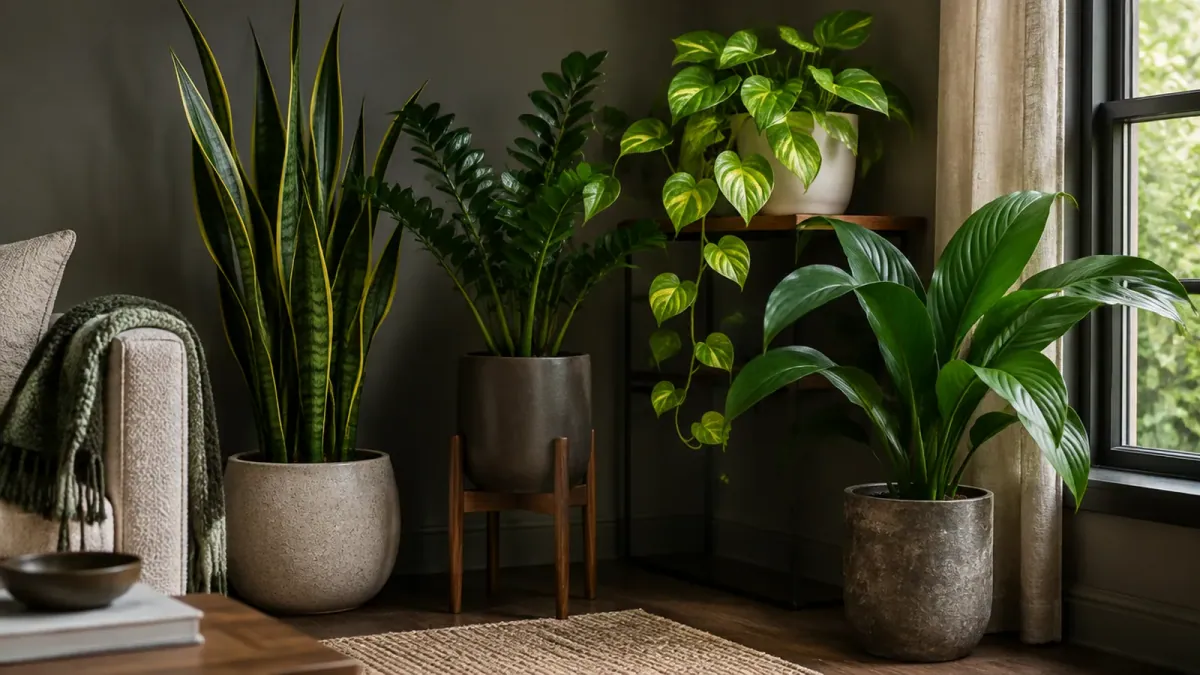
The best low light indoor plants are snake plants, ZZ plants, cast iron plants, pothos, heartleaf philodendron, Chinese evergreens, peace lilies, parlor palms and spider plants. They survive in dim rooms, but none thrives in darkness: place them within a few feet of a window or under a grow light, and water less than you would a plant in brighter conditions.
What “low light” really means
“Low light” does not mean no light. In a low-light room plants still need enough brightness to make food, and growth is slow. As a rough guide:
| Light level | What it looks like | Examples of spots |
|---|---|---|
| Low | Faint or no shadow; hard to read without a lamp | North-facing window; 6–10 ft from a bright window; shaded by a building or tree |
| Medium | Soft, blurry shadow | East-facing window; 3–5 ft from a south or west window |
| Bright indirect | Clear but soft shadow | Right beside a south or west window with a sheer curtain |
Light drops quickly with distance. A spot 3 feet from a window can receive only a fraction of the light right on the sill. For more houseplant guides, visit our indoor plants hub.
Low-light plants compared
| Plant | Light tolerance | Water | Size | Pets (ASPCA) |
|---|---|---|---|---|
| Cast iron plant | Very low to medium | Let top 2 in dry | 2–3 ft | Non-toxic |
| Snake plant | Very low to bright | Let dry out fully | 1–4 ft | Toxic |
| ZZ plant | Very low to bright | Let dry out fully | 2–4 ft | Not on the ASPCA list; treat as toxic |
| Pothos | Low to bright | Let top 2 in dry | Trailing to 6 ft+ | Toxic |
| Heartleaf philodendron | Low to bright | Let top 2 in dry | Trailing to 6 ft+ | Toxic |
| Chinese evergreen | Low to medium | Let top 2 in dry | 1–3 ft | Toxic |
| Peace lily | Low to medium | Keep slightly moist | 1–3 ft | Toxic |
| Parlor palm | Low to medium | Let top inch dry | 2–4 ft | Non-toxic |
| Spider plant | Low to bright | Let top inch dry | 1 ft with trailing plantlets | Non-toxic |
| Bamboo palm | Low to medium | Keep slightly moist | 3–6 ft | Non-toxic |
| Dracaena (corn plant) | Low to medium | Let top 2 in dry | 2–6 ft | Toxic |
| Lucky bamboo | Low to medium | Water or pebble tray | 1–3 ft | Toxic to cats and dogs (a dracaena; saponins) |
| Prayer plant | Low to medium | Keep evenly moist | 1 ft | Non-toxic |
| Boston fern | Medium; tolerates lower | Keep evenly moist | 1–3 ft | Non-toxic |
| Rattlesnake plant | Low to medium | Keep evenly moist | 1–2 ft | Non-toxic |
| Dumb cane (dieffenbachia) | Low to medium | Let top 2 in dry | 2–4 ft | Toxic |
The toughest low-light plants
1. Cast iron plant (Aspidistra elatior)
Nearly indestructible, with arching dark green leaves. It tolerates dim corners, drafts and neglect, and grows slowly. Non-toxic to cats and dogs.
2. Snake plant (Dracaena trifasciata)
Stiff, upright leaves, in several heights. It tolerates very low light and long dry spells and rots if overwatered. Water only when the soil is completely dry.
3. ZZ plant (Zamioculcas zamiifolia)
Glossy leaves on arching stems growing from water-storing rhizomes. It copes with low light and irregular watering. It isn’t on the ASPCA list, but it contains calcium oxalate crystals, so keep it away from pets.
4. Pothos (Epipremnum aureum)
A trailing classic that tolerates low light and forgives mistakes. Variegated types, such as ‘Marble Queen’, lose their patterns in very dim light.
5. Heartleaf philodendron
Heart-shaped leaves on trailing stems. Easy and fast in medium light, slower in low light.
6. Chinese evergreen (Aglaonema)
Patterned leaves in green, silver, pink and red. Darker-leaved varieties tolerate the lowest light.
7. Peace lily (Spathiphyllum)
One of the few low-light plants that flowers, with white blooms in medium light. It droops dramatically when thirsty and recovers quickly.
Low-light palms and ferns
8. Parlor palm (Chamaedorea elegans)
A small, graceful palm that suits low to medium light. Non-toxic to cats and dogs.
9. Bamboo palm
A clumping palm for low to medium light. Needs steady moisture, and is a good pet-safe choice.
10. Boston fern
Fluffy fronds that need humidity and even moisture. It tolerates lower light than most ferns but does best in medium light.
More dim-room plants
11. Spider plant
Arching striped leaves and dangling plantlets. Tolerates low light and is non-toxic to pets. Brown tips are common and often caused by fluoride or salts in tap water.
12. Dracaena
Tall, stylish and tolerant of low light. Corn plants and ‘Janet Craig’ are among the toughest.
13. Lucky bamboo
Technically a dracaena, it grows in water or soil. Change the water weekly and use filtered water if tap water causes yellowing.
14. Prayer plant (Maranta)
Patterned leaves that fold up at night. It likes humidity and even moisture. Non-toxic.
15. Rattlesnake plant
Wavy leaves with bold markings. Needs humidity and filtered water.
16. Dumb cane
Large patterned leaves. The sap irritates skin and the mouth, so keep it away from children and pets.
Caring for low-light plants
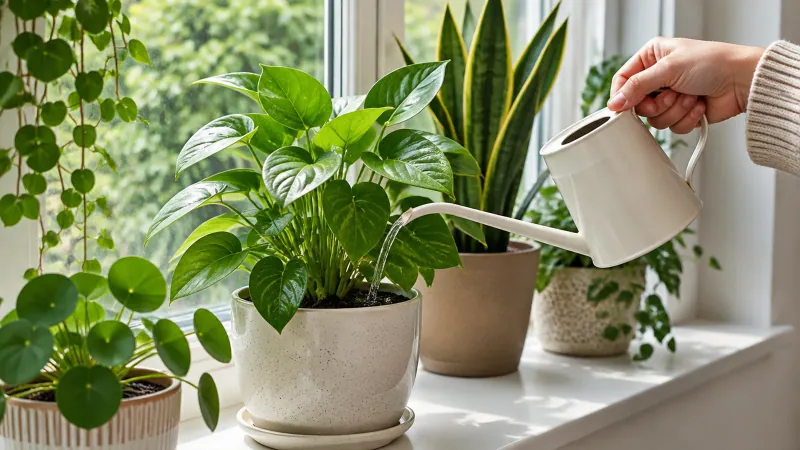
- Water less. Slow-growing plants in dim rooms use little water. Wait until the top two inches are dry (the whole pot for snake and ZZ plants). Our houseplant watering schedule explains how to check, and the guide to the signs of overwatering shows what to look for.
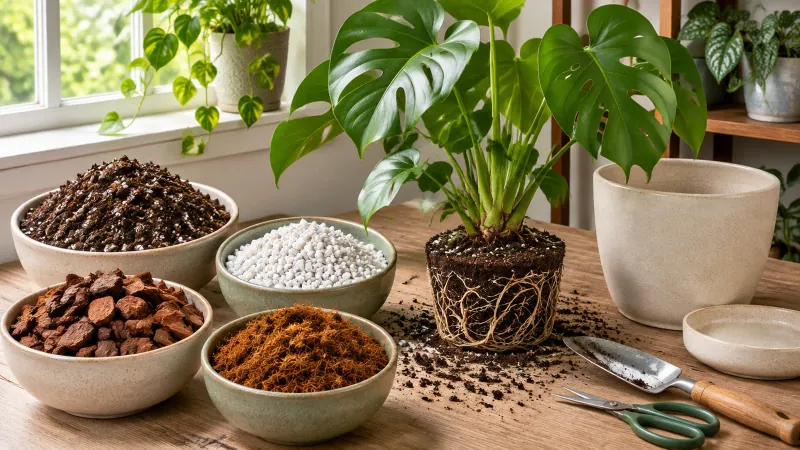
- Use a free-draining mix. A chunky potting mix reduces the risk of root rot. See our guide to the best soil for indoor plants.
- Feed sparingly. Fertilize at quarter to half strength every few months, in spring and summer only.
- Dust the leaves. Dust blocks scarce light, so wipe leaves every month or two.
- Rotate plants. Turn pots a quarter turn every couple of weeks so growth stays even.
- Swap spots. Rotate plants to a brighter place for a few weeks each season to help them recover.
Using a grow light
If a room has no windows or very little light, a grow light turns it into a growing space. A full-spectrum LED bulb in a regular lamp, placed 1 to 2 feet above the plants and run for 10 to 14 hours a day on a timer, is enough for most low-light species. Our guide to grow lights for indoor plants explains what to look for.
Low-light plants by room
| Room | Typical light | Good choices | Notes |
|---|---|---|---|
| North-facing living room | Low to medium | Cast iron plant, peace lily, Chinese evergreen, parlor palm | Place within 3–4 ft of the window |
| Bedroom | Low | Snake plant, pothos, ZZ plant | Slow growers are easy to keep alive |
| Bathroom with a small window | Low, humid | Boston fern, pothos, peace lily, lucky bamboo | Humidity helps ferns and calatheas |
| Office with fluorescent lights | Low, artificial | Pothos, ZZ plant, snake plant | Run lights on a timer; plants need a rest in the dark |
| Hallway | Very low | Cast iron plant, snake plant; rotate with brighter spots | Rotate to a brighter place every few weeks |
How seasons change your light
Light levels in a room change through the year. A window that gives medium light in summer can give low light in winter, when days are shorter and the sun sits lower. Move plants closer to the window in fall and winter, clean the glass, and cut watering as growth slows. In summer, a plant near a south or west window may need a sheer curtain to avoid scorching. Check light a few times a year rather than assuming it stays the same.
Common low-light plant problems
| Problem | Likely cause | Fix |
|---|---|---|
| Yellow, soft leaves | Overwatering | Let soil dry; check drainage; see overwatering guide |
| Long, pale, stretched stems | Too little light | Move closer to a window or add a grow light |
| Variegation fading to plain green | Not enough light | Move to brighter light; plain green varieties cope better |
| Brown leaf tips | Dry air, fluoride or salts | Use filtered water; raise humidity |
| Slow growth | Normal in low light | Be patient; don’t overfeed |
| Leaning toward the window | Uneven light | Rotate regularly |
Choosing the right plant for your space
- Dark corner, no care: cast iron plant, snake plant or ZZ plant.
- Bathroom with a small window: Boston fern, peace lily, pothos, lucky bamboo.
- Pets in the home: parlor palm, spider plant, cast iron plant, bamboo palm. See our guide to pet-safe houseplants.
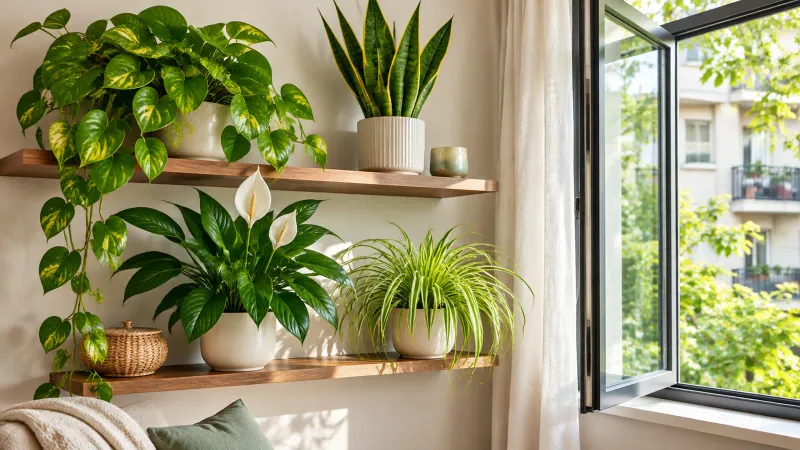
- Shelf or hanging: pothos, heartleaf philodendron, spider plant. See our guide to hanging indoor plants.
- Beginners: our list of easy houseplants for beginners has more forgiving choices.
Frequently asked questions
What are the best low light indoor plants?
The toughest low light houseplants are snake plants, ZZ plants, cast iron plants, pothos, heartleaf philodendron, Chinese evergreens, peace lilies, parlor palms and spider plants. They tolerate dim rooms, irregular watering and dry indoor air. None thrives in complete darkness, so place them within a few feet of a window or add a grow light.
Can plants live in a room with no windows?
Not without help. Plants need light to photosynthesize, and even the toughest low-light species slowly decline in a windowless room. A full-spectrum LED grow light on a timer for 10 to 14 hours a day lets many low-light plants survive in a windowless office or bathroom. Rotating plants into brighter spots occasionally also helps.
How do I know if a room is low light?
Stand where the plant will go. If you can read a book comfortably at midday without turning on a lamp but your shadow is faint or absent, the light is low to medium. If you struggle to read, it is very low. Rooms facing north, rooms with a nearby building or tree outside, and spots more than about 8 feet from a window are typically low light.
Do low light plants need less water?
Yes. Plants in dim rooms grow slowly and use water slowly, so the soil stays wet longer. Overwatering is the most common cause of death for low-light plants. Water only when the top two inches of soil are dry, empty saucers, and water less in winter. Our watering guide explains how to check the soil.
Are low light plants safe for pets?
Some are, many aren’t. According to the ASPCA, parlor palm, spider plant, cast iron plant, bamboo palm and Boston fern are non-toxic to cats and dogs. Pothos, philodendron, peace lily, snake plant and Chinese evergreen are on the ASPCA toxic list. Lucky bamboo is a dracaena, and the ASPCA lists dracaenas as toxic to cats and dogs (saponins). ZZ plant has no ASPCA entry, so keep it away from pets too. If you have pets, choose from the non-toxic group and check the ASPCA list before buying.